

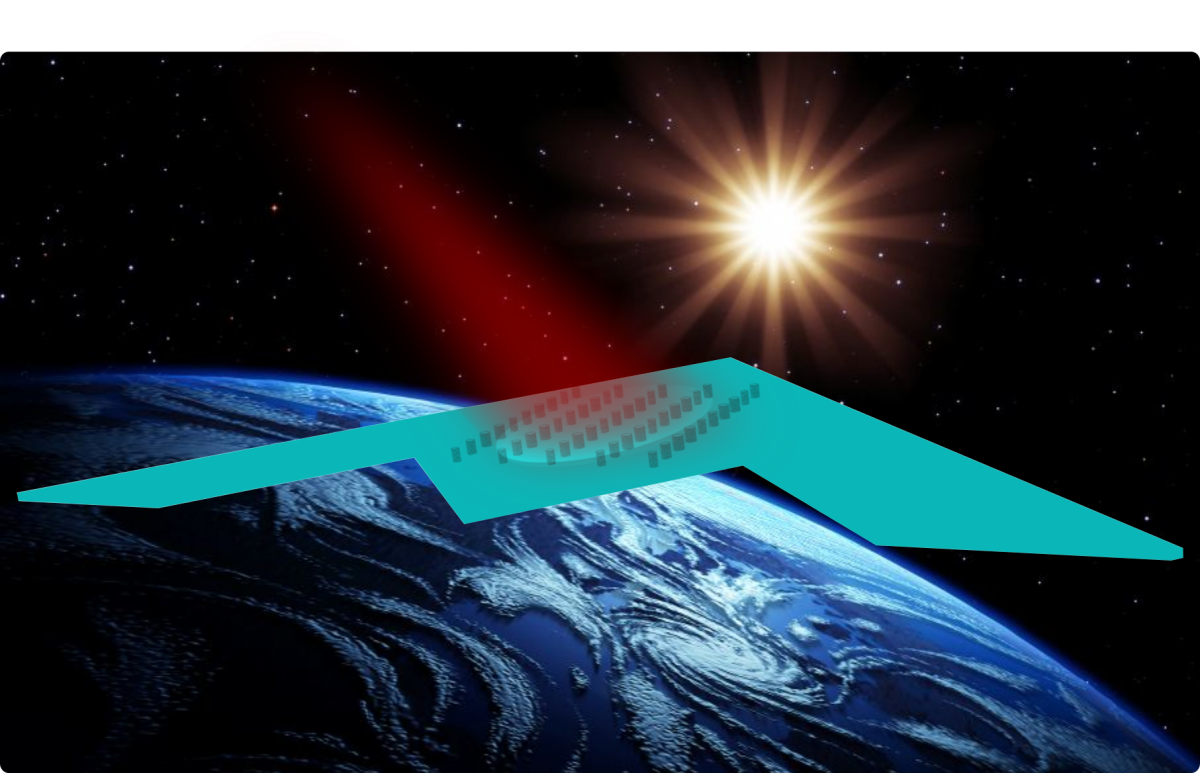
A team of Texas A&M engineering students are working on a technology called optical propulsion, which could cut travel time to the nearest star system, Alpha Centauri, from over 1,000 years to just 20.
Optical propulsion uses lasers to lift and steer objects without physical contact, according to BBC’s Sky at Night Magazine.
Optical propulsion eliminates a lot of the limitations that rocket propulsion tech currently faces, professor of thermodynamics Shoufeng Lán, Ph.D., said.
“The limitation of that is that is that you need to carry the propellant with the spacecraft,” Lán said. “That’s why we are saying instead of using propellant, using the rocket to propel the spacecraft.”
Using laser light to propel the spacecraft removes the need for carrying other energy forms, Lán said.
Lán used ping-pong balls to explain how the transfer of momentum from light propulsion lasers can accelerate an aircraft.
“You can see that the momentum of a ping-pong ball will be transferred back to the wall,” Lán said. “But if the wall is moveable, then actually that ball will propel the wall. Similarly, you can think of light as a stream of ping-pong balls. So when you have the light punching the surface, it will transfer the momentum of the light.”
The team has used the AggieFab Nanofabrication Facility to design its structures, which are smaller than one micron, about a few hundred nanometers. For reference, one human hair is about 60,000 to 100,000 nanometers wide, according to National Nanotechnology Coordinated Infrastructure.
The team’s small-scale research, however, is not limited to this size.
“The physics is there,” Lán said. “This is scalable because it’s only related to the power of light.”
This means the applications of this technology are vast and aren’t limited to space travel technology.
One example Lán used is satellites in space.
“What if we can use a laser light to move a satellite a little bit, avoid debris and then move it back,” Lán said.
Laser propulsion technology could also be used to control robots or cargo ships, Lán said.
One of his goals as the director of the Lab for Advanced Nanophotonics and as a professor of undergraduate thermodynamics is to inspire undergraduate students to get involved in research opportunities, Lán said.
“The students get excited when they say, ‘This is cool in the future, possibly we might need to find another Earth in the future,’ and we can achieve that with this [technology],” Lán said. “The application of this fundamental science of physics, that’s the motivation for students.”
Although A&M’s research team was not the one to invent optical propulsion, it is still a pioneer in the field.
“We’re not the first to invent the optical force, but we are the first to generalize the rules for this manipulation of motion, as well as the demonstration of three-dimensional maneuverability,” Lán said.
Lán said that one of the next steps for the research team involves securing funding to be able to access technology that allows them to practice their experiments in a capacity that mimics gravity in space.
The team’s ultimate goal is to be able to apply its research to real-world space travel technology.
“Overall, we want to do it more close to the real environment and also do some more of the fundamental research to control the motion of the devices or spacecraft,” Lán said. “And eventually, at the end, we want to scale it up. We want to get closer to bigger devices and more fundamentals.”