


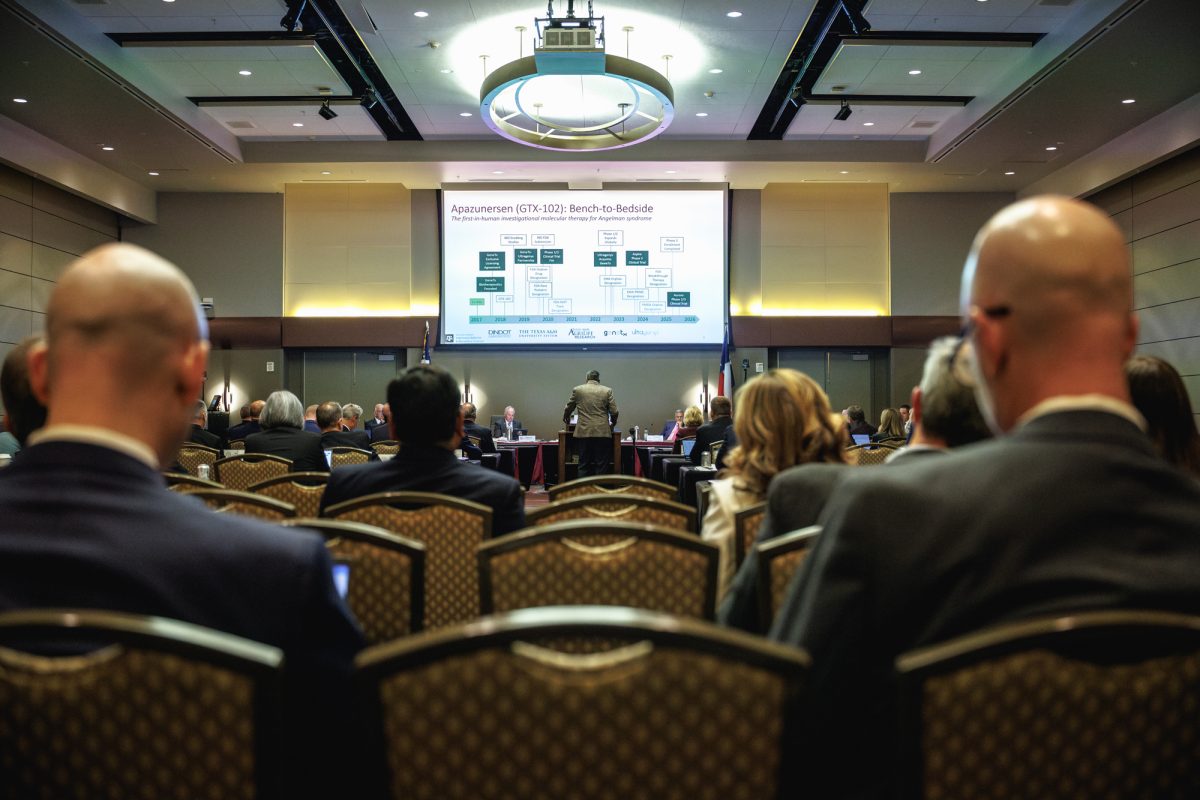
The Texas A&M University System Board of Regents voted to move the development of the new Meat Science and Technology Center from the RELLIS Campus to main campus and approved an added $18.76 million investment, bringing the total project cost to $133.36 million.
This project was relocated for several strategic purposes, including wanting to replace the aging Rosenthal Meat Science and Technology Center, bridging the gap between classroom instruction and real-world experience for students and incorporate more space and innovative technology, as the original construction plan was updated from 75,000 square feet to roughly 85,600 square feet.
Assistant Vice Chancellor for Marketing and Communications Katherine D. Hancock expanded upon the decision by the Board to relocate the center and how it aligns with A&M’s goals for its agricultural programs.
“The Meat Sciences and Technology Center is now part of an expanded strategic vision, serving as a foundational anchor for a broader agricultural facilities sector at Texas A&M University,” Hancock said. “These facilities will be developed over time to advance innovation, collaboration and long-term capacity in agricultural research, teaching and industry engagement.”
The proximity to the Kleberg Animal and Food Sciences Center and other agricultural departments is intentional and designed to ensure students currently studying animal science, poultry science, agricultural economics and food science and technology will have further access to hands-on learning opportunities to increase their skills and gain a competitive edge as they prepare themselves for future involvement in the meat industry. Hancock emphasized the variety of programs will be a part of this new project.
“Several key public-facing programs of the Texas A&M Department of Animal Science and the Department of Poultry Science will be housed in the new facility,” Hancock said.
She also commented on how students and professionals will benefit from the relocation of this facility.
“The Meat Sciences and Technology Center will serve as a new home for existing programming that targets each of these groups, and it will empower Texas A&M faculty experts to expand these offerings in innumerable ways that support student and professional development in meat and poultry production,” Hancock said.
The new development will utilize modern research laboratories and equipment, including robotics and artificial intelligence, classrooms, industry collaboration and a real meat processing floor. Hancock noted the specific applications in which the new facility will be used.
“The center will primarily focus on meat and poultry processing, applied research, teaching and extension,” Hancock said. “At roughly 85,600 square feet, the center will provide modern labs, classrooms, processing space for beef, swine, poultry, sheep and goats and spaces for hosting teaching events for the public and industry.”
The teaching events hosted at the new facility will include summer camps such as Barbecue Summer Camp, Camp Brisket and Beef 101, as well as events for Texas 4-H, an agricultural youth organization, and the National FFA Organization.
These programs will play a role in how the new center plans to help shape public understanding of meat production. With consumers becoming increasingly concerned with how their food is sourced and processed, transparency and education are becoming more important. Programs hosted at the new facility will not only help to train future professionals, but also provide opportunities for the public to learn about modern agricultural practices and food systems.
The financing for this project is supported by a system of funding channels, including revenue from AgriLife Research, A&M and private donor funds. These funds will help support infrastructural costs and the integration of advanced technology for classrooms and labs. The large investment is indicative of the confidence industry leaders possess in the long-term importance of the meat industry within Texas and the United States and could prove critical to Texas producers, meat processing companies and the overall food supply chain.
Several challenges are currently inhibiting the sustainability and expansion of the meat industry. Critical workforce shortages, reduced herd sizes — especially in Texas — supply chain disruptions, environmental concerns, increased regulatory compliance and growing demand for alternative proteins are resulting in limited supply, high input costs and decreasing demand, making it less profitable for producers.
The new center is designed to address both these challenges and develop innovative ways to help producers, processors and packers adapt to the modern market and maintain an important industry. Hancock highlighted how the facility will assist producers and processors in advancing food solutions.
“The center will serve as a home for applied technology development and scientific innovation in meat and poultry processing, from harvesting to packaging,” Hancock said. “The center will also enable the development of new and streamlined processes for teaching and extension services — a comprehensive effort to train the next generation and deliver solutions to producers in Texas, the U.S. and the world.”