

Rating: 8/10
Spoilers ahead for “Project Hail Mary.”
It was a rock. Literally just a rock. But it’s a rock that has left many people bawling and empathizing with its beauty and humanity.
If you’re wondering how a simple rock might spark a reaction like this, then I invite you to behold “Project Hail Mary,” Hollywood’s most recent box office success adapted from Andy Weir’s best selling novel of the same name and directed by giants Phil Lord and Christopher Miller, known for modern blockbuster classics like “The Lego Movie,” “Cloudy with a Chance of Meatballs” and “21 Jump Street.”
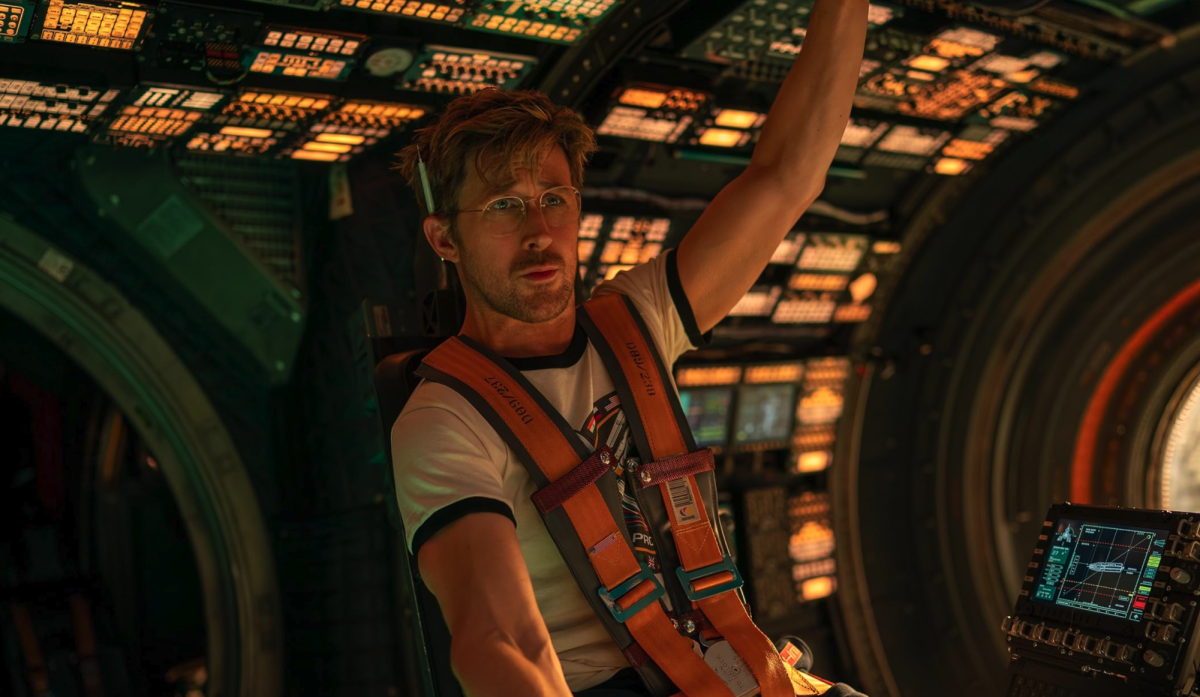
After awakening from a coma, Ryland Grace, Ph.D. — portrayed by the inspiring Ryan Gosling — finds himself alone on an unknown spacecraft with an unknown trajectory. Slowly making his way through the vessel, he finds the dead bodies of two other passengers and later discovers that he is on a mission to save Earth.
While surfing through a solar system he doesn’t recognize and slowly remembering how he got there in the first place, Grace encounters another ship — unlike one he has ever seen before — and hopes that this is what he has been sent into space in search of, the answer to Earth’s prayers.
It is then we meet the aforementioned rock — bluntly named Rocky by Grace — who has also been abandoned in the solar system and needs to find his way back to his planet. The two strike up an unlikely friendship, and they set forth on an intergalactic adventure to help save the people they love and, in the process, themselves.
Lord and Miller do a great job of balancing the comedy and drama throughout the film, a balance that many directors fail to master. Their previous directorial efforts have defined this as their prominent style of storytelling, and it translates well into this narrative.
However, it’s the performances that truly set this film apart.
Gosling is as electric as he’s ever been, navigating a character that might seem simple to portray, but in reality is a very tricky personality to get a handle on. However, he embodies Grace effortlessly, and the film only benefits from and deepens in meaning because of his performance.
The supporting cast is just as charged as he is. James Ortiz as Rocky is easily a standout, as much of his voice work helps elevate the character’s personality because he is, literally, a rock. Other performances from Lionel Boyce, Milana Vayntrub and Ken Leung — shoutout Eric Tao from “Industry” — feed into the sporadic comedic aspects of the film and are placed with intent that pays off greatly.
But it’s Sandra Hüller’s performance that I found most powerful.
At first, Eva Stratt, the head of the international task force that recruited Grace, is cold and product-driven, only caring about success and willing to do anything to get it. As she slowly becomes accustomed to Grace and her team, she doesn’t open up completely, and Hüller expertly plays her in situations that bring out the best of Stratt’s dry humor and unfeeling personality.
However, there’s a turning point within the film that takes place during a team party; the drinks are flowing, and the karaoke machine is humming with music when, unexpectedly, Stratt walks up to the microphone and starts singing “Sign of the Times” by Harry Styles, and the team is blown away.
This isn’t a performance that belongs on Madison Square Garden’s stage, but rather a raw depiction of what it means to be human. It isn’t perfect, and it shouldn’t be, but it’s the willingness to get onto the stage and perform, to belt out your heart and show true emotion in your actions, that makes the moment. This will be an iconic scene for years to come, one that compares to Adam Driver’s performance of “Being Alive” by Stephen Sondheim in “Marriage Story.”
Following Stratt’s monumental solo show, the heart of the film immediately became evident. Despite all the beauty to be found in the film’s galactic visuals and the glorious sciences that are argued over and studied by the cast of characters, this simple act of singing is the major signifier of what this film is meant to be about: It’s not the actions that give us life, but rather the meaning behind them.
Grace could’ve helped Rocky and left him, but instead decided to trust and stay with him because he cared. It’s humanity at its best, and it’s insane that a rock, an object so inhumane and insignificant, can help us learn about this.
However, the film could’ve delved deeper into this theme. While the ending is satisfactory, as it is a crowd-pleaser, I was left wanting more. It almost felt like it was supposed to be implied, but I think that it should’ve been much more explicitly said — that this is the way to be human.
Nonetheless, the movie does its job. It’s big, bold and deserves every pair of eyes gazing upon it on the biggest screen one can find. It’s films like these that reinforce my view on how impactful cinema can be, a testament to how profound an effect stories can have on audiences.
So, for some, it might’ve just been a rock. It might just be a thing you kick as you walk on the sidewalk. But for others like myself, we will always look at a random rock as Rocky and realize how something so small can be so meaningful to one’s life.
Joshua Abraham is a kinesiology senior and associate opinion editor for The Battalion.