

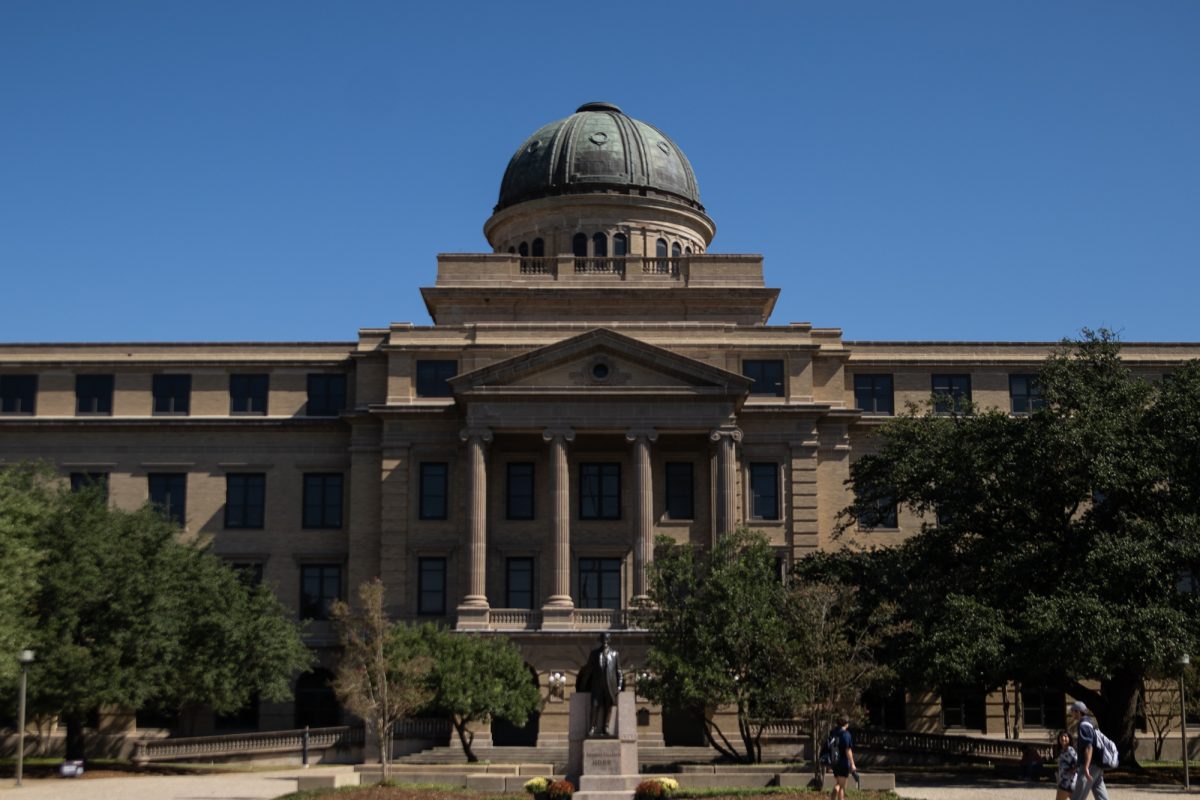
The Texas A&M chapter of the American Association of University Professors, or AAUP, held a press conference at Academic Plaza alongside A&M’s chapter of MOVE Texas to condemn attacks on academic freedom and course cancellation on Thursday, Jan. 22.
Faculty speakers at the conference included professor and President of A&M’s AAUP chapter Leonard Bright, Ph.D., philosophy professor Martin Peterson, Ph.D. and associate professor Joan Wolf, Ph.D. Civil engineering senior and Vice President of the A&M chapter of MOVE Texas Robert Day and sociology sophomore Leah Tolan also joined the panel.
“Today we demand that Texas A&M ends classroom censorship immediately, restore academic freedom to the faculty, reinstate improperly cancelled courses, let Plato out of his cage, guarantee truthful, rigorous education for our students, end all retaliation against faculty who refuse to voluntarily censor their courses, return circular authority back to the educators, back to the experts, to the faculty, protect the value in credibility of Texas A&M’s degrees and reaffirm its commitment to all of Texans,” Bright said at the press conference.
The conference comes in the wake of A&M’s recent efforts to alter over 200 core courses for undergraduate students, some of which were announced after the start of the spring semester, complicating students’ schedules and outlook for the semester.
AAUP President Todd Wolfson issued a statement on Jan. 12 condemning censorship at A&M, stating, “This censorship goes far beyond what is required by Senate Bill 37 and Texas A&M system policies.” He further claimed, “A college or university of this sort harms its students, faculty, and traditions, and consequently can no longer be regarded as a serious institution of higher learning.”
On Jan. 9, A&M forced Peterson to remove a reading of Plato’s “Symposium” from the syllabus of one of his philosophy courses, stating that, if he refused to comply, he would be reassigned to an upper level course.
“[Syllabi] exist to reduce confusion for students, not to enforce political control,” Day said. “As Aggies, we should not be afraid to speak out against administrators who are tempting to impose a narrow, externally audited version of what education should look like.”
Then, on Jan. 15, The Texas Tribune reported A&M’s decision to cancel Bright’s graduate ethics course three days after the spring semester began.
“This policy has also weaponized and targeted faculty who refuse to voluntarily participate in censorship; that is exactly what happened to me,” Bright said. “My graduate ethics course in public policy was canceled based on a flimsy and false claim that I failed to provide sufficient detail about how I would discuss some of the most important topics in my field. … When a university censors topics involving race, gender, sexuality, power and inequity, they are not protecting students, they are underpreparing them.”





Andrew Kellman • Jan 23, 2026 at 10:14 pm
College is about discussion not censorship. If a college is afraid of different voices, it ceases to be a foundation of learning
AggieMomBCS • Jan 23, 2026 at 5:33 pm
Texas A&M tuition increases year after year. In that context, asking for consistency, transparency, and accountability in coursework should not be controversial.
A set curriculum is not censorship—it is academic excellence. Many respected universities rely on professionally designed, standardized curricula to ensure students know what they are enrolling in and receive a consistent educational foundation. When a professor with limited experience in certain subject areas is allowed to ad-lib or substitute personal ideology, that is not education—it risks becoming indoctrination.
When a student enrolls in a course, the title and syllabus should accurately reflect the content. The professor’s role is to present that material using their own teaching style, character, and personality—not to redefine the course based on personal beliefs. That distinction matters.
Students’ tuition dollars pay professors’ salaries. Students should therefore have a meaningful say in what they are being taught and what standards are enforced. We are paying for instruction—not for individual professors to “run the show” as if the classroom belongs solely to them.
Too many faculty have grown far too comfortable treating it as “the professor’s classroom.” It is not. It is the students’ classroom, Texas A&M’s classroom, and ultimately the State of Texas’s classroom.
The claim, “We have to ask, what are they afraid of? Why are they afraid of students being aware of the world around them? Why do they not trust students to think, reason, and make their own decisions?” is misleading.
Students do not decide what is taught. Professors are not polling students on the curriculum. Yet students are the ones paying escalating tuition, cannot obtain refunds when a course deviates from expectations, and often do not know what they are actually getting until they are already committed.
That power imbalance matters.
While students are privileged to attend Texas A&M, professors are also privileged to teach Aggies. Teaching at a flagship public university is not an entitlement—it is a responsibility. Oversight, curriculum standards, and transparency are not attacks on academic freedom; they are safeguards for educational integrity.
Framing accountability as fear or censorship is not only dishonest—it borders on predatory. It implies nefarious intent where there is simply a reasonable demand for structure, professionalism, and value.
Transparency is not oppression.
Structure is not censorship.
And students deserve clarity, consistency, and respect for the tuition they are required to pay.