


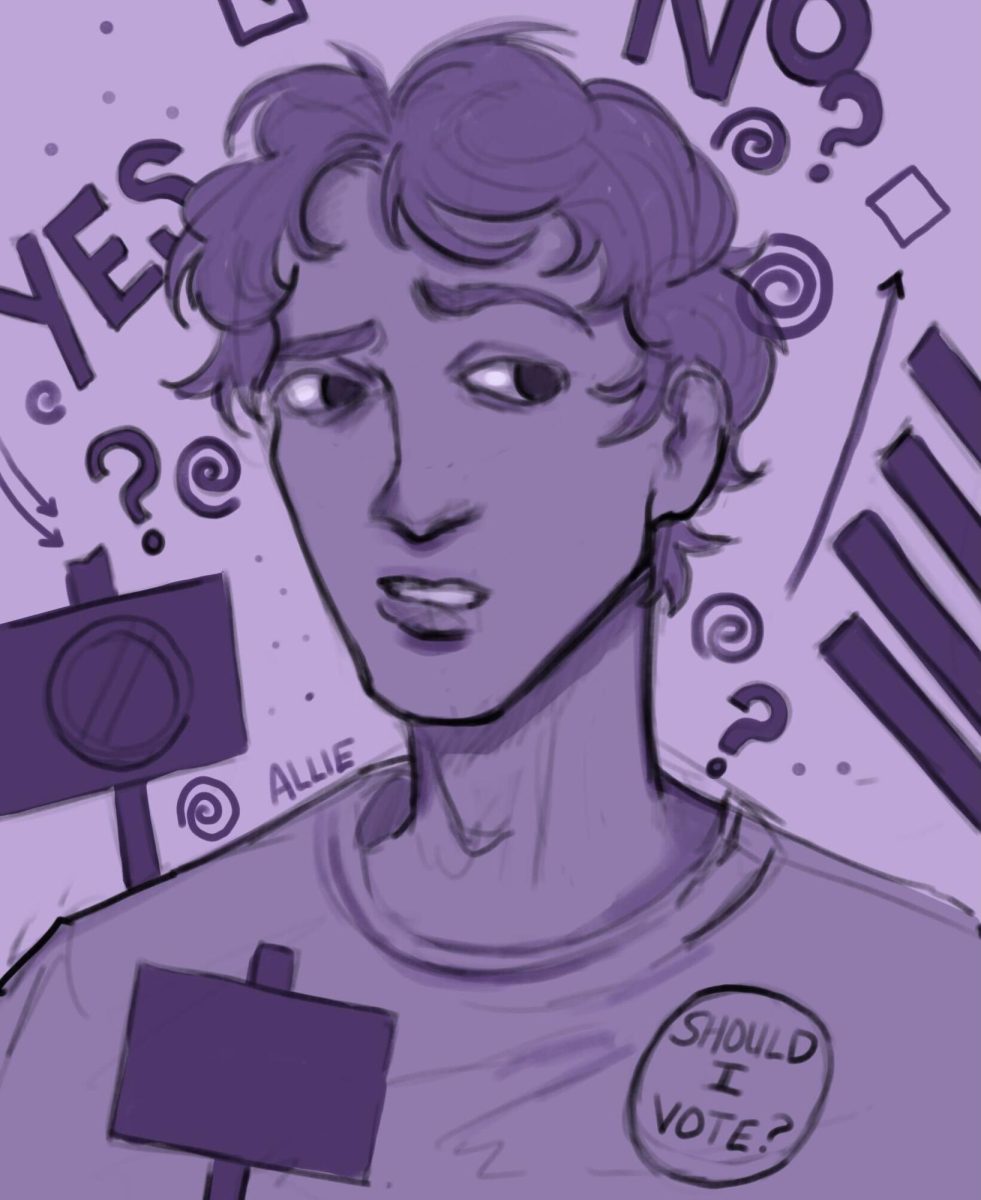
You’ve probably heard it before: “I’m not voting because the system is broken.” Among young constituents, political disengagement is increasingly framed as proof of critical thinking rather than complacency. Cynicism is packaged as awareness, and skipping elections is cast as a form of protest.
But reality is far less flattering; opting out doesn’t dismantle the system, but rather hands control to others, leaving your voice unheard. Apathy is not a moral stance — it’s a political choice with real consequences.
Young people often justify their apathy by saying that the political system is broken, leaders are corrupt and the electoral process itself is a failure. They say voting is useless when neither party adequately represents their views, all the candidates are compromised and lobbyists and special interests are in control.
But by completely withdrawing from participation, you guarantee tuition will keep going up, action on climate change will remain stalled, threats to reproductive freedom will persist and officials will continue to fail in ensuring public safety.
Sitting out doesn’t impact who sits on school boards, city councils, county commissions or other such decision-making entities whose policies shape people’s everyday lives. Sitting out isn’t resistance — it’s surrendering your rights.
The consequences of disengagement are not hypothetical. When young people don’t vote, older or more committed individuals continue to dominate local and state elections that shape our communities.
School boards make their decisions based on elections that can be decided by fewer than a thousand votes in small districts. City councils make decisions about policing budgets, parks and housing access, yet voter turnout among younger people remains shockingly low. National primary candidates are elected by highly engaged small voting blocs, setting into place a political agenda that’s unrepresentative of the general constituency for years afterward.
When young people sit out, they outsource decisions regarding tuition policy, abortion access, climate regulation and other such pressing issues without having any say in what happens.
Voting is power. It’s a tangible way of ensuring that your values are accounted for in governmental decisions. Every ballot is an opportunity to shape policies, elect leaders and decide which communities are prioritized. Disengagement is not neutral — it actively dictates election outcomes. Saying “I don’t vote because no candidate is perfect” is much like refusing to water a garden because there are weeds.
Inaction doesn’t stop the weeds from growing; it just lets them take over.
Furthermore, abstention from the political process only exacerbates existing inequities. The communities most likely to be systemically disadvantaged — lower-income neighborhoods, racial minorities and students — are already structurally disadvantaged in political participation.
By choosing to abstain, youth, who are often a large demographic of non-voters, only worsen the power gap. Young people who refuse to vote swing the political pendulum toward the interests of older, wealthier and more consistent voters.
For students at Texas A&M or elsewhere, this could mean high tuition, fewer mental health resources or less say in local government. Youth inaction tells the people in power: You decide, not me.
Some individuals maintain that activism outside of voting — via protests, social media or volunteering — is enough in itself. Such efforts have their place, but none can replace the singular power of the ballot.
Elections are not symbolic gestures; they are definitive. It’s a determination of who will and will not be legally invested with the powers to make binding decisions. Whether or not a particular campaign or protest will be impactful often depends on whether lawmakers care about the cause — and whether they care depends on whether voters give them reason to. Those contingencies shrink every time people stay home on Election Day.
No matter how passionate or well-intentioned activism outside the ballot box may be, it’s still less powerful than the vote alone.
Sitting out an election may feel like a principled stand, a righteous protest against a broken system, but it’s ultimately just an abdication of power that props up the very system it is meant to dismantle.
Real resistance starts with showing up. A vote is not an endorsement of the status quo, but rather a reminder to those in power that you can and will claim a seat at the table. Casting a ballot defends the causes you care about, shapes your community’s future and gives young people a voice in a political system that often ignores them.
The choice to abstain is yours — but it’s not morally neutral. Every skipped election allows someone else to shape your campus, city, state and country. Power is only forfeited when we refuse to claim it.
So if you care about your future, community or the policies that affect your life, the most effective protest is not absence — it is action at the ballot box. Participation is not just civic duty; it’s moral responsibility. In a democracy, refusing to vote is choosing to let others write your story for you.
Don’t let them.
Prachi Arora is a political science freshman and opinion writer for The Battalion.









Nishi Pahuja • Feb 5, 2026 at 8:26 pm
This is as an awesome post! I love all the information!
Casie Plat • Feb 5, 2026 at 5:53 pm
This was great!!! Love encouraging people to vote!
Jaedyn McNeil • Feb 5, 2026 at 5:53 pm
Very insightful!
Sydney Wingenbach • Feb 4, 2026 at 9:23 pm
This is so amazing! I love her take on how people should stay more politically involved!
cec • Feb 4, 2026 at 8:32 pm
Wow! This was so insightful and makes me want to vote in the primaries on March 3rd!
Prachi • Feb 4, 2026 at 8:11 pm
Wow this is amazing, I wonder who wrote it?