

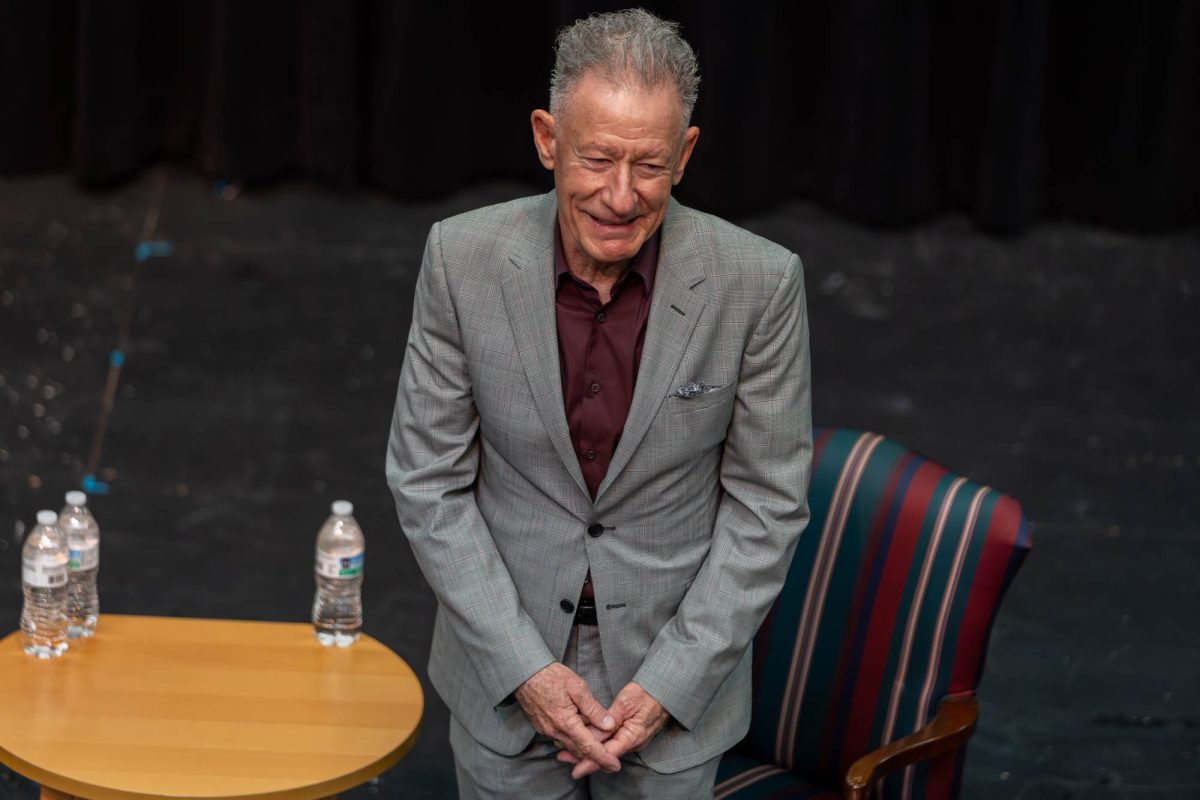
On a Wednesday morning at the Black Box Theater, two art deco pinstripe chairs sat empty in the center of the floor stage, facing 50 seats that were quickly being filled by students and others interested in the April 1 Lyle Lovett Residency Discussion. It was minutes before the presentation — camera crews from local news stations still setting up their cameras and extra chairs being pulled from the back storage room to seat the overflowing crowd — but Grammy award-winning artist Lyle Lovett ‘79 was already making his rounds, introducing himself to the audience members and camera crews alongside actor and guest speaker Thomas Sadoski.
Lovett’s Residency Discussions began in early spring as a part of his 2025-26 residency with Hagler Fellows, a Texas A&M institution for international and high-achieving scholars in their respective fields.
Fellows inducted into the institution are each assigned to a college related to their field, and Lovett, having a successful career in music, has been working closely with the College of Performance, Visualization and Fine Arts, or PVFA.
Since his discussions began, he has brought guests such Houston filmmaker Bruce Bryant, CEO of Regard Music Sean O’Malley and, for this event, Sadoski.
“Lyle and I just sort of know each other from both being from [College Station],” Sadoski said. “And when I was doing a TV show a few years back called ‘Life in Pieces,’ there was an opportunity for a guest part to come in to play an owner of a morgue, and I thought Lyle would have been perfect for it. … Next thing you know, Lyle is on set with us, working, and we’ve just been really close buddies ever since then. And he called me up and asked me if I’d like to be a part of doing this thing here at A&M, you know, getting this college off the ground, and I’m thrilled, I’m honored that he asked me. Anything that I can do to help.”
Lovett led a discussion with Sadoski that delved into his upbringing as a young actor in College Station and his experience on projects such as the off-Broadway production “This is our Youth,” where he worked as an understudy for Mark Ruffalo.
“They brought me into the dressing room, and I met Mark Ruffalo, who I was going to understudy, and Mark Rosenthal and Missy Yager and Kenny Lonergan, the playwright, Mark Brokaw, the director,” Sadoski said during the discussion. “ … I went on 25 times over the course of eight months for both parts. And during that time, Ruffalo became kind of a mentor as an artist, you know.”
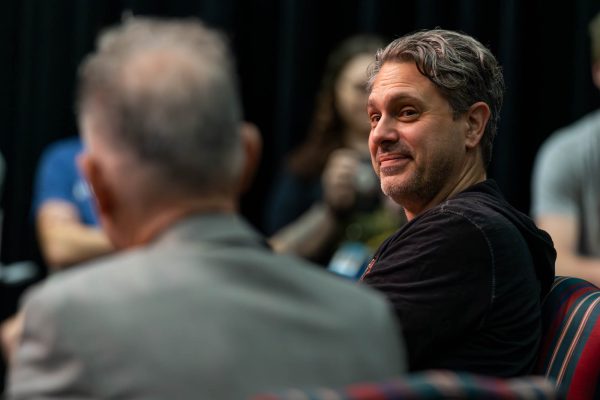
Sadoski has since worked on projects such as “Wild,” “John Wick,” “Skin and Bone” and, most recently, “Adult Children.” While Lovett’s interview revolved around Sadoski’s professional career, the two also discussed the importance of art as a whole.
“Don’t let anybody devalue you, telling you that ‘It’s a hobby’ — it’s not,” Sadoski said. “It is an essential and vital part of a society’s health. … We last longer for a reason, because we tell our stories to each other. We don’t get to learn about who we really are unless we as artists are here.”
Attendees had the opportunity at the end of the presentation to ask questions, during which many students took the chance to ask for advice pertaining to their own careers in the performing arts. As a former journalism student and writer for The Battalion who often wrote articles about local artists, Lovett said being able to interact with the same type of professionals, now as a Hagler Fellow, is a task he has always been interested in.
“I love talking to other performers about process, about how they do what they do,” Lovett said. “I mean, I think the tendency in journalism and in stories is what gets put forward all the time is the idea that, you know, our stories about our favorite movie stars, actors, musicians, how they are like us. They put their pants on one leg at a time, the same way we do. But what is truly interesting, I think, to find out about, to read about, is what makes those people special, what makes them different from us. And getting here a great actor like Tommy Sadoski to talk about his process, and how he chooses the work and the impact he’s trying to achieve with his work is fascinating.”
A typical fellow’s residency often spans for a year in the form of research or open forums. However, alongside his open forums, Lovett also visits classes within PVFA, one being Small Ensembles, or MUSC 381.
“He’s brought in some industry folks to talk about how you get your music licensed, how you copyright music, how to monetize your music as a business,” associate professor and MUSC 381 instructor Rebecca Hays said. “So that’s been really helpful for him to bring in these really giants in the music industry for our students. … I think it’s a great gift to have for our students right now.”
Hays said Lovett has been extremely hands-on and personable with the students’ songwriting processes, providing feedback and storytelling techniques, even performing his own songs on occasion.
“I just think that he’s really a visionary leader,” Hays said. “I mean, he’s been around the block. He’s been in the industry for a long time. And so, he’s got a really keen perspective as to how these students can just get started. But more than that, I think he’s willing to mentor them in a way that sets them up to ask the good questions they need to ask so they can be successful when they go out and start presenting their own art.”
Hays recalled one instance this semester when she felt Lovett’s mentoring techniques allowed a student to find the courage to perform a guitar cover in front of his fellow classmates and musicians, though he was new to music.
“Lyle was really gracious and just said, you know, ‘How many times have you performed this in front of people?’ and the student said, ‘This is my first time to sing this in front of anyone,’” Hays said. “I was just sitting there thinking, you know, what a brave thing to do. … I think that Lyle’s really got a gentle touch with the students and that he genuinely hears them for their own voice and for the uniqueness that they bring to their performance. He’s got a really gentle way of communicating with them that’s both encouraging and challenging.”
Through his time as a close mentor to students, Lovett said he has found this experience equally rewarding, because of the authenticity students exhibit in their craft.
“To see their enthusiasm, to feel their energy, to see their interest and their ability, my gosh,” Lovett said. “There’s some such talented young people here in these classes, great singers, great musicians, and I’m inspired just being in the room with them. … Most of these students aren’t experienced performers, so getting to see someone sitting in front of people for the first time, you know, that’s a very special thing.”
While Lovett continues to make regular appearances in PVFA classrooms to give his insight, he has also continued to bring professionals in for his residency discussions. On April 7, at 7 p.m., Lovett spoke with screenwriter Anne Rapp about her contributions to Robert Altman’s “Cookie’s Fortune” at Geren Auditorium, where a screening of the film was also held.
“All of us love the arts,” Lovett said. “All of us who turn on our TV and want to watch our favorite programs. We love the arts. To see that mix of students, and to see the access they have to these very accomplished professors, it’s extraordinary, really. … I mean, that’s the objective, I think. If you’re doing your part right, then that’s all you have to worry about. Art, for the sake of doing it, is really the joy. So whether you’re playing music for fun or whether you’re a pro, you’re working on something specific for performance, it’s all about the joy of doing it.”




!["2026 [Hillje, Tilly]/The Battalion. All rights reserved.”](https://thebatt.com/wp-content/uploads/2026/04/IMG_5581-1-1200x800.jpg)