

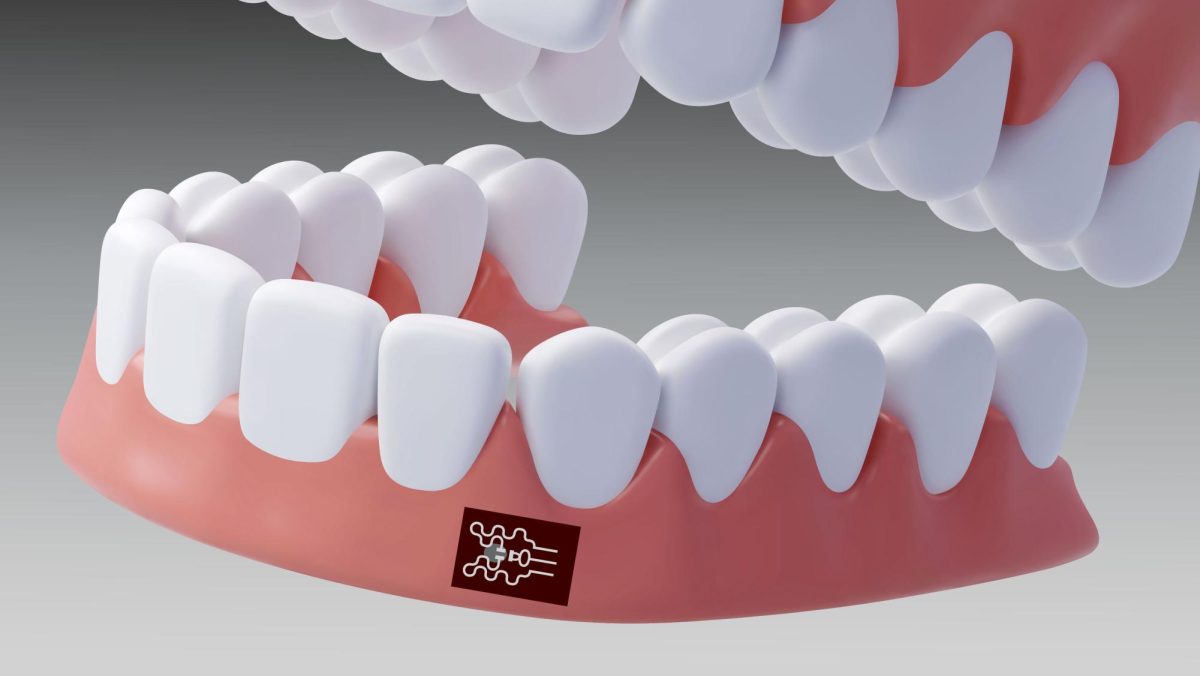
Over 40% of adults in the United States have periodontitis, a chronic progression of gum disease that destroys the soft tissue supporting teeth. Though the most common cause of tooth loss, it is difficult to detect until dentists notice visual tissue damage during manual inspection. Until now, there’s been no way to detect signs of oral inflammation in real time.
Associate professor Chenglin Wu, Ph.D., didn’t originally set out to solve this problem in the dental field. His laboratory’s work with nanomaterials began during the COVID-19 pandemic while studying the applications of MXene, an ultra-thin, metal-like inorganic compound in sensors.
“If a virus is attached on the surface of a table, it doesn’t do anything,” Wu said. “But [MXene] is so thin that anything attached to it will cause an electrical signal change on the material itself. We discovered that, and then when COVID-19 hit, we just thought, ‘Hey, we can make a sensor out of this.’”
Wu’s main collaborator on this project was Michigan State University assistant professor Shaoting Lin, Ph.D.
“We [Wu’s laboratory] were presenting our COVID-19 sensor during a conference, and then my collaborator [Lin] at the time was attending … and actually went to our presentation,” Wu said. “He really felt like we were doing solid work, not just dabbling, but really trying to put our foot in the field. And then [he] would start talking to us and thinking about ideas.”
With his background in mechanical engineering, Lin brought a fresh new perspective to the project. He helped Wu’s team engineer the selective permeability of the sensor, filtering out unwanted molecules by their size and chemical composition.
“The goal of the hydrogel is to independently control the transport of different biomolecules,” Lin said. “Specifically, it’s going to allow the passage of the biomarker while rejecting the transport of the nontargeted biomolecules. So it enhances the sensing specificity.”
Civil engineering graduate students Jiaoli Li and Weijia Liu worked under Wu on these biosensors. Two years ago, the team realized its technology could be put to use in the field of oral health.
“[Dr. Wu and I] have a periodontal disease,” Liu said. “So why can’t we use our sensor in detecting mouth conditions? I often go to the dentist, and there’s no technique to tell whether you have a disease or any infection. … That’s how we started this project.”
The final product was a multi-layer tissue-adhesive hydrogel patch that detects tumor necrosis factor-alpha, or TNF-alpha, a key biomarker for inflammation. With the hypersensitivity of MXene, the sensor can pick up TNF-alpha at a miniscule concentration of 18.2 femtograms per milliliter. For scale, a femtogram is 1 quadrillion times smaller than a gram.
Despite this breakthrough, the team ran into a large barrier when trying to test its concept: a lack of access to live specimens. Thankfully, the Wu Lab formed a connection with the A&M Naresh K. Vashisht College of Medicine, where it tested its biosensors in the mouths of guinea pigs, who share similar oral inflammation characteristics with humans.
“We had to do in vivo animal tests, but we don’t have any experience with that,” Li said. “We are from the department of civil engineering; it can be hard for us to get connected with other professors. But luckily, we got a response from the school of medicine and Dr. Jeffrey Cirillo [Ph.D.]. He’s very kind and willing to build connections with us, and he was so generous to provide us a lot of help with the animal tests.”
When considering the future of the dental biosensor project, Lin and Liu both pointed out that there is a large gap between the open-ended exploration of academia and the grounded reality of moving a product into the industry. The process requires many further steps like human clinical trials, manufacturing and pricing, which they hope to tackle as the project moves forward.
“The industry has a different standard than academia,” Lin said. “They actually focus on the cost; they also care about the scalability. … It’s a long-term effort that actually requires different thought processes, trying to make all this happen. This is really a collaboration and partnership through different disciplines, different sectors.”



!["2026 [Hillje, Tilly]/The Battalion. All rights reserved.”](https://thebatt.com/wp-content/uploads/2026/04/IMG_5581-1-1200x800.jpg)