


“I want to make the world a better place” has lost a certain kind of social currency at institutions like ours. Worse, we may not even believe ourselves when we say it.
The Board of Regents has taken considerable steps to make our community a worse, less welcoming environment to learn in, such that our classrooms are exceptionally unfortunate places to be studying marginalized disciplines, namely those in the humanities.
Texas A&M has been treated like a swing state, politicians rigorously tearing through what they perceive to be a battleground ripe for partisan screaming matches. Or perhaps A&M has long been the target of an interventionist’s regime change, civilians subjected to contradictory plans before being reduced to casualties. Our perceived instability seems familiar, if not traditional.
So far, the most devastating realization about our not-so-new normal is the way in which A&M perceives itself. We are already seen as pawns by our state and have more or less become acclimated to this reality. The more passive we become, the more we begin to believe more in a ruthless game and less in ourselves.
The fascistic overtones of the recently implemented Civil Rights Protections and Compliance policy pushes us toward madness and spitefulness, but not necessarily toward a form of pragmatic resistance.
Though there are administrators and professors who are always working behind the scenes, some of us students may avert our eyes with graduation just around the corner and our lives right behind that door. For some professors, that door might be tenure. It cannot be overstated that many educators all over the country have volunteered their self-restraint, all without actually having to violate real laws or rules.
Our situation points to a rudimentary truth: Such policies are carried out not through brute, obvious force — our own version of the Gestapo is too busy on the streets racially profiling and detaining innocent civilians — but by our professors who internalize it and eventually consent to it.
In other words, we are compliant when we choose to be.
The 08.01 policy didn’t convince, let alone force, any faculty member to fall in line. Yes, it cannot be overstated that it is a terrible time to be an educator, susceptible to retaliation from one’s own institution. But nothing really changed — only in digitalized ink do these rules exist.
There wouldn’t be a magnificent struggle against the Board of Regents’ decision to purge whatever it thought wokeness was. Still, no self-respecting professor should have bent a knee to rules they themselves knew were capricious and therefore hard to actually violate the rules’ intellectual lousiness.
At the brink of our wistful — though enlightened — lunacy, we might have succumbed to very little pressure. And now our righteous condemnations risk becoming echos in an empty cave.
Somewhere along the road, we may have forgotten how our right to a well-rounded public education was fought over and hard-won. Our centuries-old project spent theorizing how students can be best transformed into dignified citizens has begun to crumble — but not for the grand reasons we expected.
Like a game of Jenga, all that apparently needed to be snatched from the foundations of education was what we’ve termed “academic freedom.” We’ve rallied behind this term for some time, but from a bird’s eye view, our regents were already entirely too volatile, too quick to suppress the humanities. Our affliction goes beyond academic freedom, which alone cannot redeem our education system.
This is how our semester is playing out: If you are a humanities student who learns from the vantage point of gendered and racial experiences, your discipline is automatically registered as suspicious by the 08.01 policy.
Some faculty take it upon themselves to self-censor, perhaps by misinterpreting already unintelligible rules and exaggerating their scope. Play it safe, as it were. Yet again, the only thing going for this policy is its own absurdity — and perhaps its fragrant stupidity. Unfortunately for us, it looks like that was enough to do us in.
If professors act in accordance with the rules against “racial ideology,” their decision to do so is a disservice equal to, or even greater than, that of the nine regents to implement such policies.
The Board of Regents’ matter-of-factness in their own magical thinking has severely undermined A&M’s integrity as they automatically regard the humanities as suspicious. Simply put, this university asks you to engage in learning using a 10-foot pole. You are asked to engage in academia through the eyes of the unnamed arbiters of “gender and racial ideology” and its wayward interpreters — the regents. Yet, it’s professors who would be enabling it.
And many students still believe it is not our problem to fix.
What does it mean for a student to graduate from an institution that chooses to alienate them from meaningful discourse? The answer is simple: We create citizens who cannot think for themselves, and therefore force them to depend on the very faulty systems that produced such policies in the first place.
For instance, teaching the historical legacies of structural racism in America could count against a professor according to the “racial ideology” definition. Likewise, the university believes it can train students to report their professors to an ethics hotline.
The vernacular of white supremacy has made a shelter out of this policy since it is used to dismiss and significantly downplay structural racism. That is its intended effect, even though an anti-racial ideology policy cannot possibly prove that educational content makes students feel guilty for their ancestry. This bloated verbiage subsumes the very civil rights procedures that were meant to protect students from discrimination.
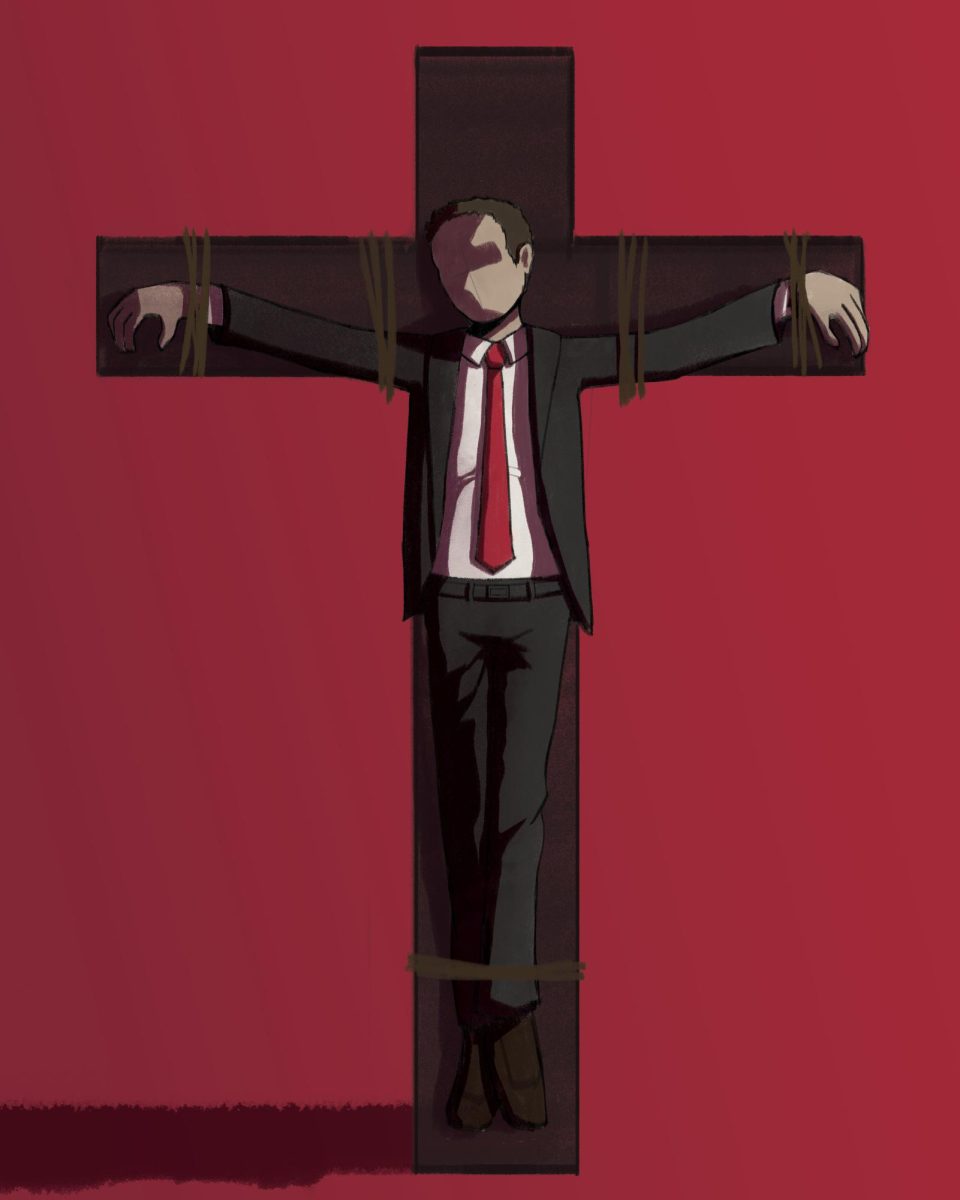
This is how fascism can operate: It hollows out and corrupts existing institutions that reward docility.
The university presents the ethics hotline as a resource, but it has greater accessibility because of this politically terse policy. This incentivizes fear-based behavior over critical thinking and, therefore, action.
At this point, some professors may contend to themselves that they have every right to be emotionally upset, but for the most part remain mystified by their own obligations toward students and vice versa.
The solution always seems to be on the tip of our faculties’ tongues, but regardless of how they’ve named the issue — “freedom of speech,” “academic freedom” or “independence from politicians” — that form of resistance is just not being felt.
Some of our faculty seem to have numbed themselves with the 08.01 policy. After all, it’s their career on the line and going against what’s already been decided may feel like pulling teeth. But when we comply, we also agree to put students under a kind of anesthesia designed to make the severing of their wisdom teeth a lot quicker. It would be like their intellect was never there.
Our campus defangs itself, yet we act like we’ve been poached for our ivory tusks. We martyrs must be kidding ourselves.
It is impossible to prepare students for the “real world” when they’re already drowning in the world of 08.01. And our ignorance as students serves as a better form of currency for those who are pained by the humanities’ emphasis on the cultivation of compassion for the other.
Unfortunately, the humanities, or more specifically the passive people who don’t resist in the humanities, do not help serve as a counterweight to fascism. Although this claim may mistake the humanities as something other than a discipline for its own sake, the humanities cannot and will not survive this wave of fascism if that be its only ambition.
We know this because rules that mandate self-imposed censorship make our own oppression invisible.
On a deeper level, we risk proceeding towards a quiet death. It is a death so cynical it betrays our longing to be known and cared for. It’s unjust because it stifles our desire for sincerity. It’s self-defeatist and we pay exponentially with our livelihoods, as if we accrue debt for loving what makes us human. Eventually we flirt with our own prolonged despair, and if we accept spiritual homelessness here on earth, we may even end up making heaven uninhabitable.
Faculty already know they must act prudently and freely. They must not uphold a false truce between educators and a state that continuously sabotages its students. It’s obvious that we’ve walked into bad deals, but a kind of deal that can be — and in the past has been — refused.
In order to actually build the kind of world we can thrive in, students, too, need to resist what they know to be not only false, but egregiously soulless. May we muster up some dignity and build a world worth living in.
Sidney Uy is a philosophy junior and opinion columnist for The Battalion.