


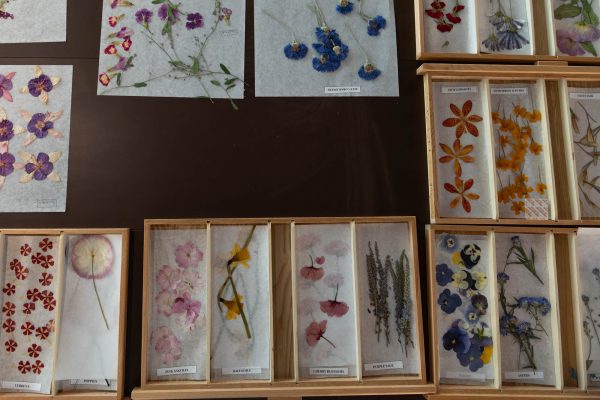
Fragile, delicate flowers litter the table, each representing a different meaning: chrysanthemums symbolizing friendship and joy, daisies exploring the purity of life and roses emphasizing love and beauty. With classical music gently humming overhead, students carefully place dried flowers in thoughtful combinations across the page, communicating messages with the petals. In addition to the Forsyth Galleries’ newest exhibition, “Discovering the Languages of Flowers,” university art gallery classes serve as a supplemental activity where students get the chance to create, relax and share with others.
Year-round, the Forsyth Galleries are filled with glistening art in antique frames, gnarled wood in the form of furniture and plush benches for attendees to rest in thoughtful reflection and examination. Students can find the Forsyth Galleries on the second floor of the MSC, directly above the first floor’s J. Wayne Stark Galleries. For many students, the galleries serve as a place to examine art, take a phone call or even hold club meetings. In one of the most bustling buildings on campus, these rooms find beauty in being calm and at peace.
Floriography: message in petals
Curator of Education and Public Programs Savannah Nichols began Creative University Art Galleries classes, or Creative UART, in the Forsyth Galleries in September 2025. Her mission was to empower the students and staff of Texas A&M to experience the galleries by creating events that complement their current exhibitions.
“When I started here in August, we didn’t have this program [Creative UART],” Nichols said. “I really wanted to bring more people in to see the exhibitions and to connect to the art. So then I decided to open it up to students, staff and faculty and create an art project that relates to the medium that the artist uses.”
For “Discovering the Languages of Flowers,” the class included a pressed flower workshop to understand floriography, the communication of messages through flowers, and appreciate the intricacies of symbolic meanings and messages.
Nichols has hosted classes from printmaking to oil pastels depending on the exhibit currently on display, walking the students through the creation process step by step. Offered about once a month over four different days and times, the classes often fill up quickly, according to Nichols, and will continue to be a monthly staple for many students and staff for years to come.
Shifting mindsets: art movements
Nichols said that the hands-on creation of the art itself with Creative UART classes offers a new perspective on interacting with the specific art movement and artist.
“When a student walks into the exhibition, sometimes they don’t know how the art is created or what they’re looking at,” Nichols said. “So when they started creating the art itself, it gives them more of an appreciation and more of an understanding of maybe what the artist was thinking when they were making the art or why they made it that way.”
Creative UART Assistant Director Elizabeth Appleby said that this shift often allows the mind to slow down and appreciate elements of the art that may be underappreciated; to her, it is often a superpower to simply sit in this artistic mindset.
“A lot of classes, even engineering classes, come in here sometimes and actually do exercises staring at art,” Appleby said. “ … They really have to sit and look at it and just figure out what they’re seeing. Try to create like you know a bridge between what they’re seeing and what they’re feeling, what the person made it might’ve felt, why they made it and just kind of create a narrative inside their head that really gives them an out-of-body [feeling].”
Ultimately, Appleby said art is not simply found in galleries or exhibitions. Art is everywhere: in flowers, in school, in life.
“There’s art in everything we do,” Appleby said. “I mean, there’s art in engineering, veterinary science and all these disciplines. So looking at or experiencing art can really just, you know, give you a reset. And I feel like coming in here can just be a nice 15-minute break.”
“Discovering the Languages of Flowers” will remain on display until July 14.
Lost art: creativity
However, just as there is a shift in utilizing the artistic mindset, Nichols said that the shift away from creativity from childhood to adulthood, especially in the modern era, has changed the artistic landscape. Classes, like the ones Creative UART offers, provide a bit of fresh air from a world consumed by technology.
“One of my family members, she’s 8 years old and has never picked a flower from the ground,” Nichols said. “ … So I don’t know, I think it’s refreshing.”
Appleby discussed the possibility that this might be an excuse for how many people see art, especially in the modern era, as immature. Appleby said that hands-on creation has a superpower: to not only change one’s perspective, but also to ultimately improve their whole day.
“[Many people say,] ‘Oh, a child could do this,’” Appleby said. “Then you should … Because it is fun, and it is relaxing and just being around here and doing those types of things; it can make your day better.”


!["2026 [Hillje, Tilly]/The Battalion. All rights reserved.”](https://thebatt.com/wp-content/uploads/2026/04/IMG_5581-1-1200x800.jpg)