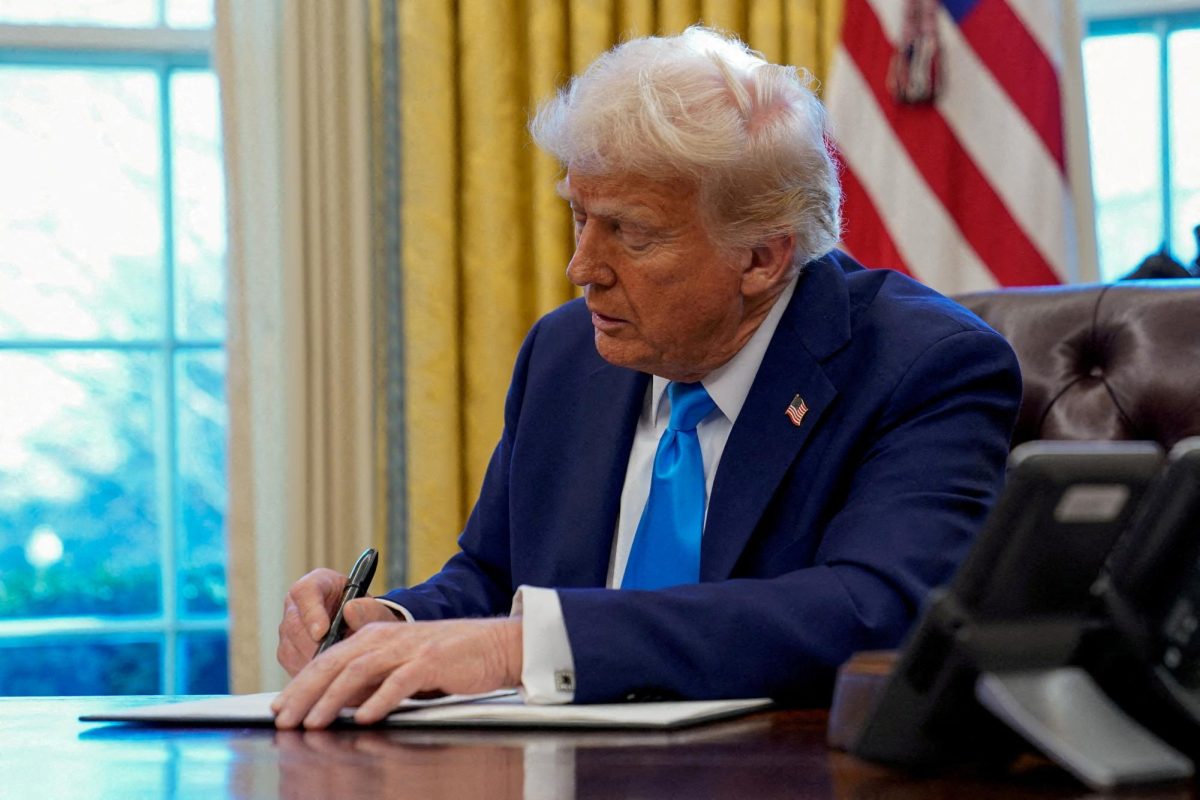



The United States Senate unanimously agreed to pass the Epstein Files Transparency Act after it passed in the House of Representatives with a final vote of 427-1. President Donald Trump signed the bill into law the following day, Nov. 19.
The new law requires the Department of Justice, or DOJ, to release all documents pertaining to child sex offender Jeffrey Epstein and his former girlfriend, Ghislaine Maxwell, who is serving a 20-year sentence in Bryan’s Federal Prison Camp for child sex trafficking.
The documents must be made available within 30 days of Trump’s signature — before Dec. 19.
The official summary of the act states that the DOJ must “publish (in a searchable and downloadable format) all unclassified records, documents, communications, and investigative materials in DOJ’s possession that relate to the investigation and prosecution of Jeffrey Epstein. This includes (1) materials that relate to Ghislaine Maxwell, (2) flight logs and travel records, and (3) individuals named or referenced (including government officials) in connection with the investigation and prosecution of Jeffrey Epstein.”
However, the bill grants the DOJ permission to “withhold certain information such as the personal information of victims and materials that would jeopardize an active federal investigation.”
Rep. Clay Higgins (R-LA) was the sole member of the House to oppose the legislation in the 427-1 vote and later posted his perspective on X.
“As written, this bill reveals and injures thousands of innocent people — witnesses, people who provided alibis, family members, etc.,” Higgins wrote. “If enacted in its current form, this type of broad reveal of criminal investigative files, released to a rabid media, will absolutely result in innocent people being hurt. Not by my vote.”
Up until recently, Higgins was not the only person standing against the act. Trump, who previously stood against the release of the files, reversed his position with a substantial social media post on Truth Social on Nov. 19.
“I HAVE JUST SIGNED THE BILL TO RELEASE THE EPSTEIN FILES!” Trump wrote. “ … At my direction, the Department of Justice has already turned over close to fifty thousand pages of documents to Congress. … Democrats have used the ‘Epstein’ issue, which affects them far more than the Republican Party, in order to try and distract from our AMAZING Victories.”
Although stipulations within the bill allow for redactions upon release, the bill specifies that “no record shall be withheld, delayed, or redacted on the basis of embarrassment, reputational harm, or political sensitivity, including to any government official, public figure, or foreign dignitary.”
While the files may not include an official client list, names of high-profile individuals will likely be revealed in the declassification, as the bill calls for flight logs and individuals connected with Epstein’s prosecution.
In a memo from July, the Federal Bureau of Investigation, or FBI, stated that there is “no incriminating ‘client list.’” The FBI also stated that there was “no credible evidence found that Epstein blackmailed prominent individuals as part of his actions.”
Despite the lack of an official client list, some names have surfaced as the subject of declassified emails, including Trump, co-founder of Palantir Technologies Peter Thiel, former President Bill Clinton and Prince Andrew, among others.
King Charles III stripped Andrew of his titles and evicted him from the royal residence in October after an email revealed Andrew’s illicit affiliation with Epstein abuse survivor Virginia Giuffre.
“We are in this together,” Andrew wrote to Epstein in an email after a photo of himself with his arm around Giuffre was initially released in 2011.
The same photo also featured Maxwell in the background, who continues to serve her 20-year sentence in Bryan’s Federal Prison Camp for child sex trafficking, where she is allegedly receiving “special treatment,” according to Noella Turnage, a fired federal prison nurse.
“There was the whole thing about closing down the compound for her to have a visit,” Turnage said, claiming that Maxwell’s family visited the prison for private meetings under the guise of legal consultations.
Turnage lost her job after sharing Maxwell’s emails with members of the House Judiciary Committee in Washington, D.C., making national headlines.