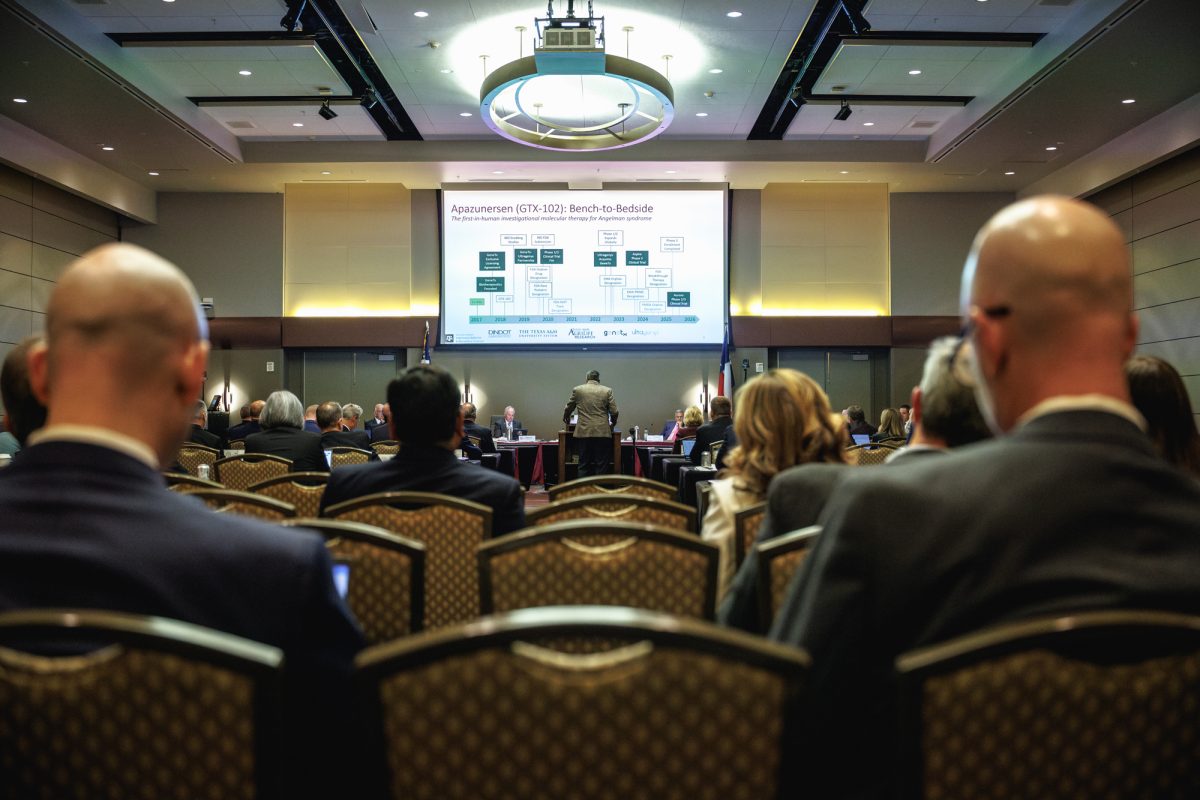



The Bush School of Government and Public Service presented a conference hosted by the Scowcroft Institute on Tuesday, Sept. 16, focusing on the current political climate of Syria.
The conference, titled “Syria at a Crossroads,” invited Syrian experts from across the world to engage in civil discourse regarding the future of the nation amidst contentions over Syria’s interim government.
After breakout sessions from 12:45 to 5 p.m., four keynote speakers concluded the event with speeches and an audience Q-and-A in the Annenberg Presidential Conference Center auditorium.
Syrian Minister of Education Mohammed Abdul Rahman Turko, Ph.D., was scheduled to give the first keynote speech of the evening, accompanied by a student Arabic translator from the Bush School. However, Turko unexpectedly left the room when he was offered the floor, declaring that he did not wish to speak.
It was not until the conclusion of the session at 7 p.m. that Director of the Scowcroft Institute of International Affairs and Ambassador (Ret.) John Hennessey-Niland revealed further details.
“You might be wondering where we’ve been,” Hennessey-Niland said. “The minister’s been in constant contact, even though it’s very early in the morning in Damascus. Many senior officials are traveling imminently to the United States. I take that as important progress.”
Hennessey-Niland urged the audience to read Turko’s prepared speech for themselves, which was available online through a QR code at the conference.
Hennessey-Niland’s remarks were followed by a passionate sentiment from the Dean of the Bush School, John Sherman.
“I want to thank our panelists, and I get it; the minister had to peel off, and I guarantee you that President George H.W. Bush, after whom this school is named, is applauding wherever he is,” Sherman said.
After Turko’s unexpected departure, the floor was offered to former Israeli Ambassador to the United States, Itamar Rabinovich. Rabinovich previously held positions as chief negotiator with Syria and President of Tel Aviv University in Israel.
“I was planning to respond to the minister, but I guess we’ll have to skip that part,” Rabinovich said.
Rabinovich began his speech with Syrian history, emphasizing the ongoing unrest within the nation, and recognized Ahmed al-Sharaa, the president of Syria’s interim government, as a former jihadi.
“Can a former jihadi … change his colors and become a mainstream political leader?” Rabinovich asked.
While Rabinovich said it was risky to predict Syrian politics, he stood fast in his belief that the new interim regime ruling Syria posed more questions than answers for the nation’s future.
“I am not leaving you with an exclamation mark, but a question mark,” Rabinovich said.
Founder and director of Orient Research Center – DC, or ORC-DC, Dr. Samir Altaqi was next to speak.
Altaqi presented many concerns in his speech, chiefly that of Syria’s recent army training, which consists of three weeks of military training and three weeks of Islamist training.
“And if you read the books, I don’t know where this will lead the country,” Altaqi said. “They didn’t come here to build up a civil democratic country in Syria … they came for something totally different.”
Altaqi advised that Syria should remove itself from possible conflict, fearing that every regional power player would ultimately intervene to take parts of Syria for themselves if the nation became a conflict zone.
This culminated with Altaqi’s concern of Turkish-trained Syrian soldiers, saying neither Saudi Arabia nor Israel would desire Turkish troops along their borders.
Altaqi encouraged a decentralization negotiation with the interim government, suggesting that the new Syrian leaders need to be guided in the right direction to avoid total fragmentation.
“If this regime will fail, the whole of Syria may fail,” Altaqi said. “There would be no more Syria.”
The final panelist was Assistant Professor of International Relations and Security Measures at Duquesne University Dina Al Raffie, Ph.D., who said she approached the discussion primarily from an angle of ideology.
“It is possible to have individuals that go from being violent jihadis to being somewhat more moderate in their Islamist beliefs,” Raffie said.
Although she recognized the potential ideological change for Ahmed al-Sharaa, Raffie did not believe the president’s Islamist intentions were completely off the table and cited his professional demeanor as a pragmatic strategy to gain economic strength and consolidate power.
Four years remain out of the allotted five years given to the interim government, and Ahmed al-Sharaa is already able to hand-pick 70 of 210 seats in the Syrian parliament. The remaining seats are selected by subcommittees of a primary committee that Ahmed al-Sharaa himself appointed, according to Raffie.
Raffie also addressed how 3,500 foreign fighters who fought prior to the overthrow of the previous government are being integrated into the Syrian army.
“I’m not entirely sure how that’s not a recipe for potential future disaster,” Raffie said.
After their speeches, the panelists partook in a Q-and-A session with the audience, with topics ranging from the role of women and students in the Syrian conflict to that of the U.S., Turkey and Israel.
One audience member asked about the top challenges facing Syria, which most panelists agreed were Ahmed al-Sharaa’s dangerous consolidation of power and the risk of future fragmentation of the country.