


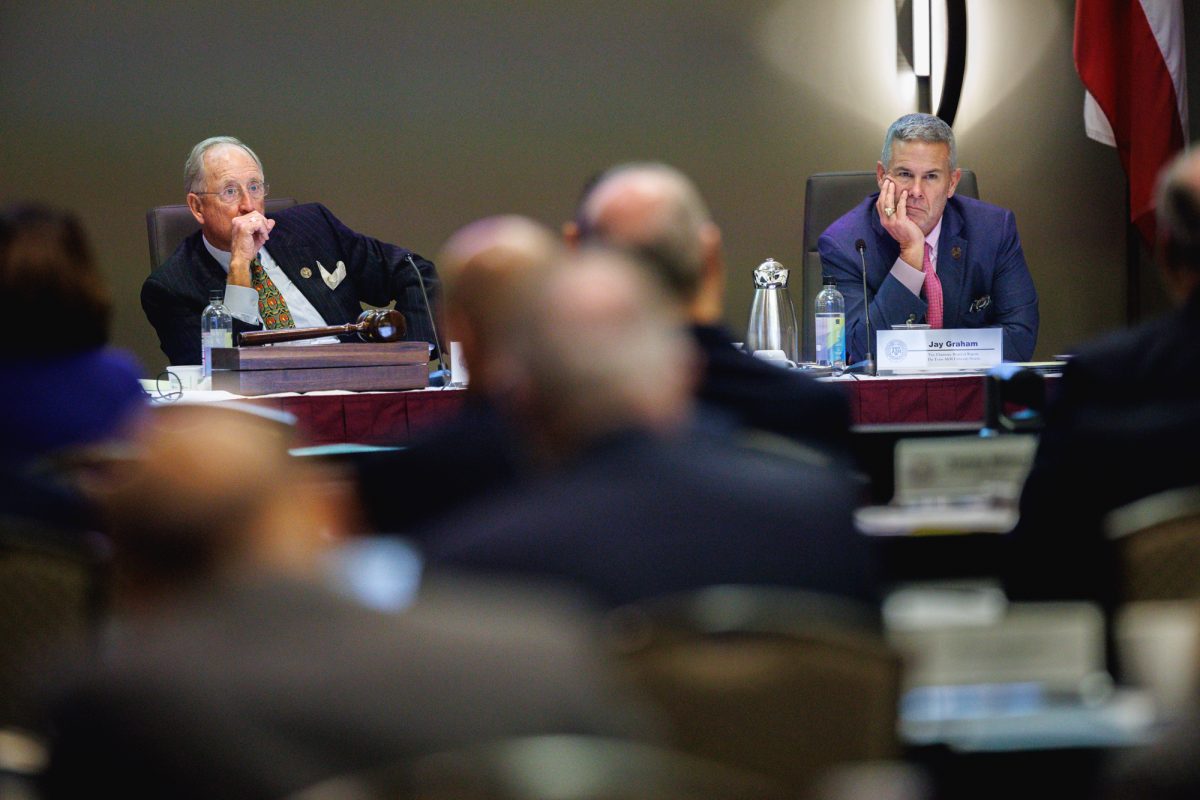
A time comes when silence starts to feel like betrayal. That time for me is now, as I watch the Texas A&M University System Board of Regents bow to political pressure and shirk its obligations to preserve academic freedom and institutional independence.
Independence is a cornerstone of institutional excellence. I think this is especially true for educational institutions. That is why a mandate for independence is embedded into existing Texas law and into current System policy. But a Dec. 10, 2025, investigative news article from The Texas Tribune exposed how System regents have allowed undue political influence to affect our university in significant ways.
More recent reports chronicle how political influence has reached directly into classrooms. Late last year, regents imposed restrictions on how faculty can talk to students about race and gender. A&M then killed an entire program — women and gender studies in the College of Arts & Sciences — and canceled six classes, including a graduate course on ethics, of all things. In an untold number of other classes, faculty and administrators are censoring curricula. One example involves limiting the philosophies of Plato.
I watch these alarming matters closely because I am a proud former student, Class of 1958, who has actively supported decades of efforts — beginning with those of former A&M President Earl Rudder — to transform my beloved alma mater from the small, all-male military college I once attended to one of America’s genuinely great public universities.
Law and policy
Regents are flouting two provisions of Texas statute. Responsibility of Governing Boards of the Education Code says it’s the duty of each governing board to “preserve institutional independence and to defend its right to manage its own affairs through its chosen administrators and employees.” Section 1.2(a) of A&M’s Board of Regents policy mirrors that provision. The state’s Education Code goes on to say that each university must “protect intellectual exploration and academic freedom” and “strive for intellectual excellence.”
To me, it appears that our regents are failing in their sworn duty to uphold state law. In The Texas Tribune article, Chairman Robert L. Albritton ‘71 acknowledged that regents have made key decisions either in compliance with the wishes of Gov. Greg Abbott or to alleviate other political pressure coming from Austin.
For example, Abbott directed then-Chancellor John Sharp to close the university’s thriving campus in Qatar. The Texas Tribune reported that, for reasons still unexplained, Abbott directed the action after visiting Israeli Prime Minister Benjamin Netanyahu.
When the Board voted in February 2024 to begin a shutdown, there was no mention of Abbott or Netanyahu, no public discussion and no explanation offered for the decision beyond general concern regarding political instability in the region. According to the contract between A&M and a Qatari foundation, A&M received $76.2 million per year for the Qatar campus.
Also in The Texas Tribune article, Albritton admitted that the governor was involved in evaluating the performance of former President Mark A. Welsh III, former chief of staff of the United States Air Force, who was forced to resign as A&M’s president in September 2025. Welsh had been deemed too “woke” in his handling of several culture war skirmishes, but in my opinion, the loss of Welsh is a colossal governance mistake likely to have a lasting negative impact on the university.
In a letter of unanimous support, the executive committee of A&M’s distinguished professors said that Welsh’s removal “would not only deprive Texas A&M of an exceptional president, but also risk worsening the university’s reputation for instability in leadership, an issue that has already drawn national attention.”
Eight of the 9 regents who presided over his ouster had hired Welsh only two years earlier. He became president at a time of high institutional uncertainty, with his predecessor — M. Katherine Banks, Ph.D. — having departed after her perceived mishandling of a separate culture war skirmish. She had lasted just two years, which is about the average tenure these days. All told, there have been five presidents and three interim presidents at A&M since Robert Gates left in December 2006.
What comes next?
All who care about A&M’s future should be on high alert about the search for our university’s next president. The appointed individual must be free of political loyalty or influence and must be independent enough to lead a still-aspiring university toward excellence. A&M’s decisions, policies and actions should be guided by its own rules, professional standards and legal frameworks.
The current Board is also ignoring best practices endorsed by a previous Board of Regents in 1999 through a project called Vision 2020.
More than 25 years ago, I was honored to be co-chairman of Vision 2020, alongside then-President Ray Bowen, Ph.D. Bowen called together more than 250 individuals associated with A&M for thousands of hours of deliberation spanning over three years. The aim was to raise the stature of A&M and place it among the best public universities in the nation.
The Vision 2020 report said that “To achieve our aspirations, strong, enlightened, stable, and forward-thinking leadership focused on academic quality is essential.” It called for regents to take the policy high ground and make decisions through a process characterized by openness and appropriate faculty and staff participation. It also said that “Academic progress is fragile. Enlightened, shared governance and leadership are elemental to its achievement.”
The regents of 1999 resolved that the principles of Vision 2020 guide the future direction of A&M. They encouraged future regents, chancellors, presidents, administrators, faculty, staff and students to honor those principles.
Vision 2020 is in sync with the state statutes demanding institutional independence and academic freedom. They dovetail nicely with U.S. Supreme Court precedents, including a 1967 ruling which stated, “Our Nation is deeply committed to safeguarding academic freedom, which is of transcendent value to all of us and not merely to the teachers concerned. That freedom is therefore a special concern of the First Amendment, which does not tolerate laws that cast a pall of orthodoxy over the classroom.”
Micromanaging
I have empathy for the regents of 2026. All nine are Aggies, and I suspect they love A&M enough to see themselves protecting its interests, given that state politicians are threatening to slash funding if the System fails to heed their complaints about DEI and LGBTQ+ policies or claims of liberal indoctrination. I imagine the regents also feel pressure with the sitting U.S. president accusing universities of turning college students into communists and terrorist sympathizers.
But these hyperbolic claims do not stand up to scrutiny, especially at such a place as A&M. The claims give our students — who are young adults, not young children — zero credit for independent thinking, and they grant faculty persuasive power they simply do not have.
The willingness of state officials to intervene in managing A&M comes despite a prolonged period of declining per-student state funding. A&M has had to replace this public support with private dollars; today, alumni-led fundraising through the Texas A&M Foundation provides roughly $200 million each year to the university — money that now sustains core academic functions once funded by the state.
It’s ironic that state officials want to micromanage our university more than ever while our donors bear more of its financial burden than ever.
During the 2025 session, the Legislature formally curtailed the faculty’s role in governance while spelling out an explicit function for governing boards in overseeing course curricula. The Legislature also created a higher education ombudsman’s office with the power to investigate allegations of violations, including complaints that universities still promote DEI.
But recent changes in the law did not force A&M to eliminate entire fields of study related to race, gender and sexuality — that was a choice made by our regents. They are overachievers in their subservience to powerful politicians.
Meanwhile, Texas lawmakers have not rescinded the statute that defines the Board of Regents’ role as an independent one. The Board still operates under the system policy intended to reinforce that independence and has not rescinded its endorsement of Vision 2020. The dissonance is deafening.
The last thing A&M needs is political obedience. Rather, it deserves courageous governance. It needs a Board of Regents that obeys the laws of Texas and the policies of the System, a Board that recommits to the principles of institutional independence and academic freedom that have enabled A&M’s decades of great progress toward excellence.
Postscript
To date, I have been disappointed that members of the Board of Regents have failed to respond substantively to the facts and conclusions of my previously released article.
I challenge the Board to address specifically how its actions of the past several years do not violate Texas state statute, most notably the sections of the Education Code that require the Board to “preserve institutional independence” and “protect academic freedom.”
It must also publicly disclose how many courses at A&M have been forced to change their curricula in response to the Board’s policy regulating speech on race and gender issues — One administrator last month estimated the number would reach roughly 200 in the College of Arts & Sciences alone.
Finally, it needs to scrutinize how its regulation of race and gender speech at a public university does not violate First Amendment protections that have been articulated and affirmed by the U.S. Supreme Court.
I call on the Aggie family, especially students and faculty, to speak out and protest and to decisively defeat the excessive politicization of this wonderful university.
Jon Hagler ‘58 is a guest contributor to The Battalion. He was the lead donor for the Hagler Institute for Advanced Study, which annually brings renowned scholars to Texas A&M for a year to collaborate with faculty and students. He also received an honorary doctorate from Texas A&M in 2015.






Doug Matthews • Feb 13, 2026 at 7:39 pm
Well said, Jon. The Aggies need more like you to speak out.