


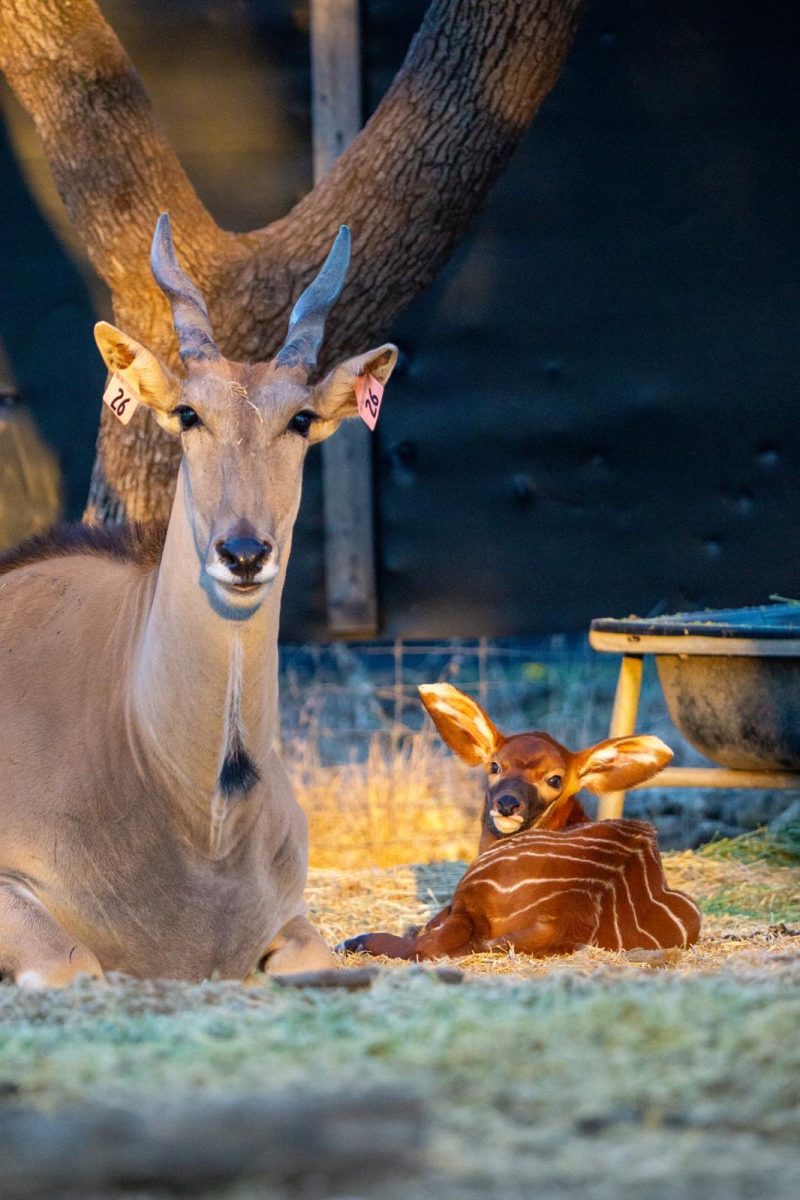
Typically, a groundbreaking scientific achievement and decades of work come to light under the high-quality sterile lighting of a lab or an operating room.
For Dr. Will Weise ‘09, though, that milestone was realized under the buzzing LEDs of a QuikTrip.
Weise, a veterinarian on the project, wasn’t at the scene when the first critically endangered bongo was born via eland surrogate, forced instead to watch the sudden birth on his cell phone in the gas station. But the Texas A&M graduate’s fingerprints were nonetheless all over the pioneering breakthrough.
In collaboration with Infinity Exotics, a privately owned wildlife preserve in Meridian that houses some of the endangered bongo — an antelope native to Kenya, with around 100 left in the wild — Weise was a part of the team that used “super ovulation” to put bongo embryos into the much more common surrogate eland.
“We give them medications so that they super ovulate,” Weise said. “ … Instead of just ovulating once, we’re getting six embryos every time, and we can do it four or five times a year per animal. The idea is we take, instead of one baby a year, those embryos and put them into surrogates … and we can really, really increase the population numbers really quickly. Like 20x potentially.”
In November 2025, the fruit of decades of labor and research was born. Pope, a healthy male calf, became the living, breathing proof of what had been conceptualized in the 1980s. Pope still resides at Infinity Exotics where, to the mild surprise of the researchers, his surrogate mother immediately began caring for him following his birth.
“I am so proud to be able to do this, it’s maybe an accomplishment that I’ll never be able to surpass,” Weise said. “I do feel very protective of him. I’m always on the phone checking with the caretakers, making sure he’s OK. He’s a beast; he’s a big old boy, and he’s nice and healthy.”
The calf’s name holds a special meaning to those who worked on the project. Earle Pope, Ph.D., a pioneer in the field, performed an interspecies embryonic transfer between a bongo and an eland in 1983.
“He shared his wealth of knowledge with me and kind of got us started in the right direction,” Weise said. “He was just somebody who inspired us, so we named our baby in his honor.”
Though the foundation was laid decades earlier, technology and financing needed time to catch up, with the project building a bridge between different generations of research.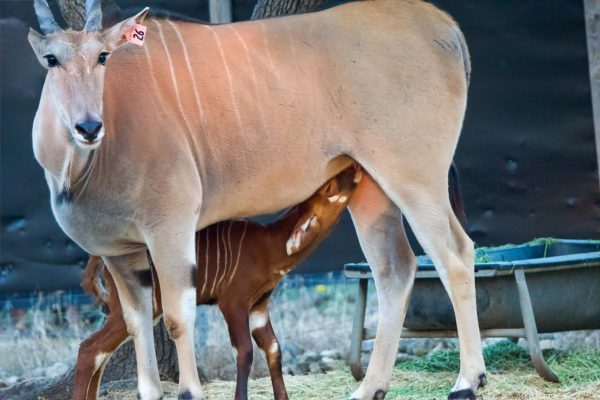
For Exotic Wildlife Veterinary Service Founder Dr. Brittni East ‘13, another veterinarian who worked with Weise, this project was conceived as a means of “conserving wild populations of animals by using captive animals as a model.”
According to East, that model has only been feasible with the help of private conservationists. Brent Teeter, founder and owner of Infinity Exotics, provided the animals that made the research possible. Without the partnership, the breakthrough may have remained theoretical.
“Conservation is about ensuring these animals have a future, and that requires both commitment and innovation,” Teeter wrote in a statement. “At Infinity Exotics, we’ve proven that what was once considered aspirational is now achievable, and that opens doors for endangered and exotic animals worldwide. … This breakthrough signals that we may now have the tools, techniques and precision needed to bring these methods into mainstream conservation practice.”
Pope’s successful birth and healthy status mirrors other high-stakes conservation efforts across the globe to prevent species extinction. In Kenya, the planet’s two remaining northern white rhinoceroses are housed in Ol Pejeta Conservancy, a private sanctuary where similar cross-species embryonic transfers are being conducted to save the animal from extinction.
East said her small-scale efforts with the bongo can be applied to other species and that with the continued help of private conservationists, preventing extinction is an achievable goal.
“It proved that science continues despite all odds as long as you’re driven enough and you believe in it enough,” East said. “It’s the first of what I hope will be many wildlife conservation reproductive efforts that are done in the private sector. … My hope is that it would be inspiring to like young entrepreneurs or young scientists, be that at A&M or anywhere else.”
For Weise, Pope has given him hope that the light is now being shone on the value of interspecies embryonic transfers. Weise said that it’s “outrageous” to have animals still going extinct in 2026 when the resources are available to stop it.
“Extinction is a solvable problem,” Weise said. “We have the technology to do it. I know we can do it.”









!["2026 [Hillje, Tilly]/The Battalion. All rights reserved.”](https://thebatt.com/wp-content/uploads/2026/04/IMG_5581-1-1200x800.jpg)

Charis • Apr 7, 2026 at 9:59 pm
incredibly common Mathias w
Mathias Cubillan • Apr 8, 2026 at 4:22 pm
from the goat herself <3