


Before she took her first breath, doctors said Hunter Adkins had a zero percent chance of survival. Born with cerebral palsy, or CP, she miraculously survived after an emergency cesarean section despite the odds against her — but was destined for life in a wheelchair. She would struggle every day to talk, smile or simply hold a fork.
Now in her forties, Hunter has been appointed to the Texas State Independent Living Council in Austin to advocate for people with developmental disabilities. Turning her condition into a source of strength, she shares her story to encourage and inspire others.
“I was so terrified for her during the birth,” Hunter’s mother, Becky Adkins, said in the documentary “Where the Horses Heal the Soul.” “But ever since she came out, and on my birthday no less, she kept fighting. That spirit was born with her.”
At 14 years old, Hunter began equine-assisted services at Ride on Center for Kids, or ROCK, in Georgetown. ROCK is a Texas-based therapy organization where riders build strength in weakened muscles through repetitive exercises that harness a horse’s natural rhythm.
After years of equine-assisted therapy with ROCK, Hunter took control of her life. She regained use of her arms and legs, improved her balance and strengthened her fine motor skills. She’s even picked up a few hobbies: snowboarding, rock climbing, scuba diving and more. But her favorite has always been horseback riding.
“Horses gave me life,” Hunter said after winning the 2019 Professional Association of Therapeutic Horsemanship International, or PATH, Adult Equestrian of the Year. “A lot of the time when you’re in a wheelchair, people judge you. Most people say, ‘You can’t do that.’ I say, ‘You wanna bet?’”
In the heart of Aggieland
Texas A&M’s Courtney Cares is a program that offers equine-assisted services, or EAS, to veterans and people with physical disabilities, cognitive conditions and injuries. Affiliated with ROCK, Courtney Cares also offers an eight-week course in the fall and spring that teaches students how to administer EAS in the College of Veterinary Medicine & Biomedical Sciences.
Founded in 2012 with a $1.2 million donation from the family of the late Courtney Grimshaw ‘85, the program offers riders a chance to connect with horses and lead more confident, independent lives.
Nancy Krenek, Ph.D., executive director of Courtney Cares, founder of ROCK, a PATH-certified instructor and a physical therapist at A&M, got the program off the ground.
“I give my heart and soul to teach others about the miracles of equine therapy,” Krenek said. “I drive about two hours from Georgetown to College Station twice a week to facilitate therapy, and I wouldn’t have it any other way. It’s a blessing to teach these bright students and watch their clients’ progress throughout the semester.”
Reining in the science
Every living being on Earth has what’s called a gait, or a pattern of moving. It’s a sequence of foot movements that allow all creatures to walk, crawl or run.
A horse’s gait is special: it perfectly mimics the motions of a three-dimensional human walk. EAS simulates walking for people with disabilities, training muscles, bones, and the brain to adopt new movement patterns — much like how children learn to walk in early development.
Courtney Cares’ PATH-certified instructor, physical therapist and guest instructor at A&M Priscilla Lightsey, Ph.D., says there are seven components that make a horse’s walk ideal for physical therapy.
“It’s frequent, consistent, rhythmical, bilateral, symmetrical and cyclical,” Lightsey said. “When a client rides, they are getting repetitive treatment. Each time the horse’s hoof hits the ground, the rider will make a postural adjustment. Whether they’re aware of it or not, they’re getting a neuromuscular reeducation.”
For riders with CP, like Hunter, EAS can build the strength needed for greater independence. For example, Lightsey worked with a CP client who used “bicycle-handle” reins that are specially designed to build muscle dexterity in the fingers.
“As the horse walks, the rider’s arms and hands are receiving sensory input, slowly allowing muscles to gain strength and relearn movement,” Lightsey said.
Over time, repeated practice turned into progress. The client’s muscles strengthened until they could hold the reins for an entire session without dropping them.
“Then, the real magic happened,” Lightsey said. “After eight weeks of riding, the client held a spoon at the dinner table.”
For most people, holding a spoon is second nature. But for Lightsey’s client, gripping utensils and eating by themself was a daily struggle — one that’s all too common for those with CP. Through EAS, repeated practice with the bicycle reins improved dexterity, offering not just motor skill improvement but a measure of independence.
“What we’re looking for is to see what’s happening in the arena translated into functional skills when they’re off the horse and at home,” Lightsey said.
At Courtney Cares, Krenek said that choosing the right horse is just as important as the therapy itself. Program Director Donelle Beal says the key quality is temperament: Horses must stay calm while carrying riders with diverse conditions and remain unfazed by a crowd of helpers.
“The horses we look for need to be able to walk with … people around them and stand still, despite a rider throwing a toy, dropping something or simply being off balance,” Beal said.
Good horses are hard to come by, so Courtney Cares partners with the Corps of Cadets’ Parsons Mounted Cavalry. Parsons’s horses are accustomed to active crowds, like loud noises from parades and A&M football games, making them ideal for the job.
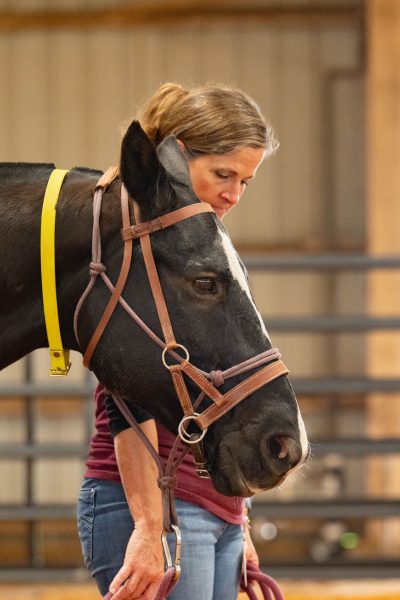
“They are very level-headed horses,” Beal said. “If they are under stress, they maintain their composure. They can handle a person changing positions on their back — riding sideways or backwards — and deal with flying objects.”
EAS isn’t limited to physical therapy. The program also supports clients with mental health conditions such as depression or anxiety, as developing a relationship with a horse fosters connection. Somatic corrections, such as improved posture, can improve breathing, speech and language. Over time, Lightsey has also seen many riders develop coping strategies and healthier ways to process their emotions.
“We use the term ‘equine assisted services’ to cover an umbrella of disabilities,” Lightsey said. “Multiple sclerosis, Parkinson’s, cerebral palsy, autism, speech and language and mental health are all included. But a lot of the time, it’s the horse and human connection that underlies everything. The horse is the common denominator.”
Laying the groundwork
While many people may have witnessed miracles from EAS, Krenek said there is a lack of scientific literature to confirm it. Courtney Cares and ROCK are taking that next step.
“Research in the field of equine-assisted therapy is so important because it allows us to see the why,” Krenek said. “You can have a theory, but until you test it, it won’t be fact. Why wonder if it will work? We intend to find out.”
In a 2021 pilot study, Krenek and Lightsey worked with four children with CP over eight therapy sessions. They used inertial measurement units, or IMUs — sensor devices that measure an object’s movement in three dimensions — to capture data. The devices were mounted on the children’ s helmets and on the horses’ bodies to record motion during each session.
In conjunction with A&M’s College of Engineering, the study confirmed that the children’s neuromuscular systems became increasingly synchronized to the gait of the horse’s walk over time.
Today, Courtney Cares is working to explore the effect of EAS on those with Parkinson’s disease. By using the same IMU technology, they plan to measure both horse and client movement in the pelvic region, seeking changes or improvements in balance skills over time.
“When you give people with disabilities the choice of movement and an outlet to help themselves, they come alive,” Krenek said. “It helps them open up to who they really are and lets those labels that society defines them as fall away.”
Riding into the future
With a recent move under the direction of Craig Huffhines at the A&M Institute for Equine Sciences, Huffhines hopes to expand the number of clients, services and horses offered by Courtney Cares in the future.
“A horse is an equalizer,” Huffhines said. “EAS is the biggest promoter of diversity and not in the political way. It doesn’t matter your background, who you are or where you come from. Anyone can come and be themselves around horses. Our goal at Courtney Cares is to help as many people as we can lead better lives.”
Huffhines said there are plans to collaborate with several organizations at A&M, including the Department of Kinesiology, the College of Engineering and even Baylor Scott & White Medical Center – College Station.
“We have many people who want to use the services we offer, but we only have so many people and horses to go around,” Lightsey said.
Expansion would also provide opportunities for more research studies. Lightsey said she is interested in studying whether EAS can create new neural pathways in the brain.
“The spirit of the horse is very unique,” Krenek said. “Our bodies were created to move and so were theirs. I’d love to share that with as many people as I can.”


!["2026 [Hillje, Tilly]/The Battalion. All rights reserved.”](https://thebatt.com/wp-content/uploads/2026/04/IMG_5581-1-1200x800.jpg)