


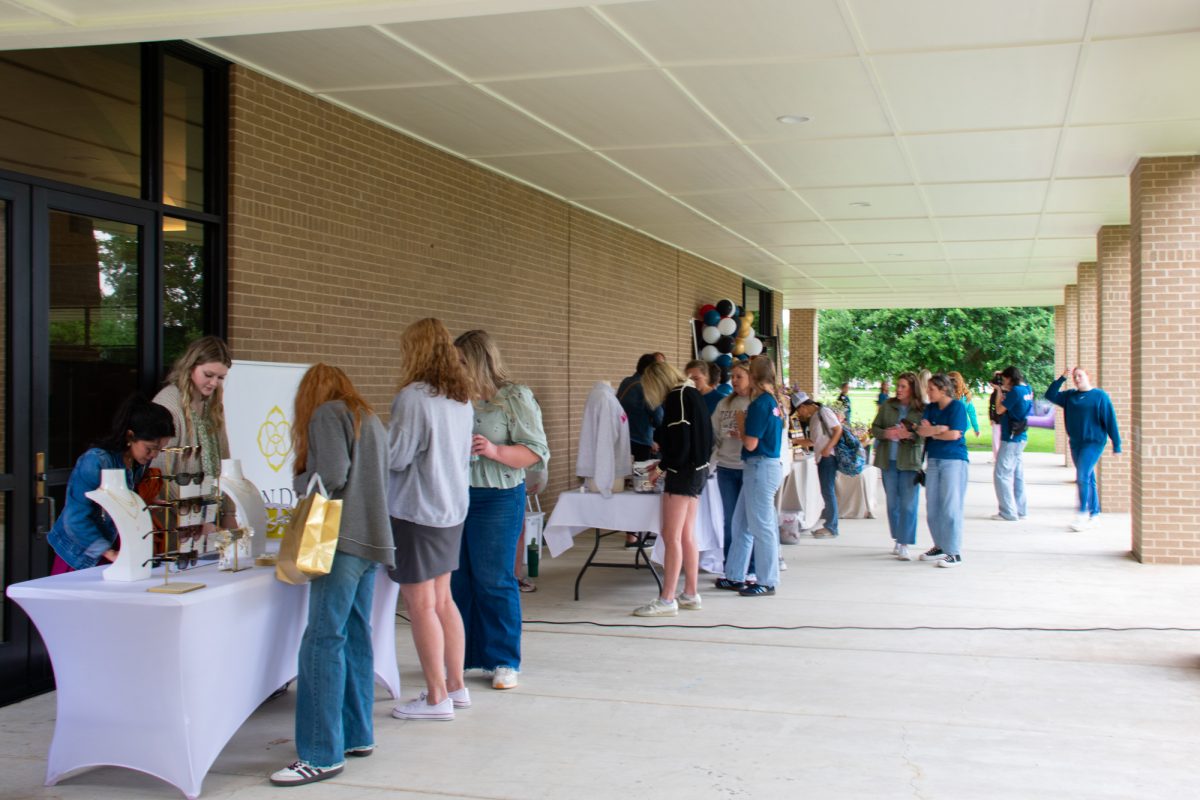
On the evening of March 27, Aggie Park overflowed with students and families dressed in traditional Indian kurtas and lehengas. Two rows of bright orange booths stretched across the lawn, sporting informational posters about cultural traditions and offering everything from authentic chai, a spiced tea, to mehndi, an Indian temporary tattoo art. It was a New Year’s celebration in the middle of March.
For many Indian families, international students and immigrants in Bryan-College Station, it can be difficult to find a community that celebrates the full diversity of the religious holidays of Hinduism. To close this gap, the first-ever Texas A&M chapter of Hindu Youth for Unity, Virtue and Action, better known as Hindu YUVA, was founded in 2022. On March 27, the organization’s volunteers gathered to host their third annual Hindu New Year festival, a symbolic event that marks the beginning of the Hindu lunisolar calendar.
Hindu YUVA Marketing Officer and biomedical engineering junior Aditya Krishna explained that this holiday is unique because of how differently it is celebrated in various regions of India.
“[This event is] tailored to specific cultures rather than just a general Hindu event,” Krishna said. “For example, I’m from Tamilnadu myself, so there’s a booth for that. There’s also a booth for Telugu, for Hindi. So it’s very tailored to what you speak and what you know.”
At the event check-in, each visitor had the opportunity to grab a “cultural passport” and collect colorful stamps from volunteers manning posters at various booths, each representing a distinct culture within India and their respective New Year’s traditions. According to Krishna, the goal of this interactive element was to emphasize that India — consisting of 28 states that speak over 121 languages combined — is not a monolith, with the same holiday being celebrated in radically different ways between regions.

One poster featured information about the traditional clothes, foods and dances that make up Nutan Varsh, the New Year’s tradition celebrated by the Gujarati people. Another focused on the version of the holiday observed by Telugu and Kannada speakers, a festival named Ugadi that’s centered around a flavorful mango dish called Ugadi Pachadi.
“It’s a nice aspect that isn’t really shown in events that are just a general gathering of Hindus,” Krishna said. “In this community here, and you get to see some pretty cool performances, and the best part is probably bringing along your friends and making even more friends.”
As crowds of visitors sprawled across the main lawn at Aggie Park and socialized, they turned their eyes to the performances onstage. The opening performer of the evening, economics junior Nischintha Srinivasan, sang in a music style commonly practiced in South India.
“I’m trained in Carnatic music, which is Indian classical singing,” Srinivasan said. “I actually grew up in India, in Bangalore, and I was put into those classes and have been learning music for about probably 10 years.”
Srinivasan performed the classical Tamil song “Maadu Meikum Kanne,” a staple at religious holidays. First composed in the 18th century, the lyrics are a tender dialogue between the Hindu god Krishna and his mother.
Chemical engineering graduate student Divyang Patel, who recently moved to College Station from the Indian state of Gujarat, also had the chance to perform the songs “Tum Prem Ho” and “Mithe Ras Se Bharyo Radha Rani Lage.”
“I can sing bhajans and devotional songs very well, and they gave me a platform to do that,” Patel said. “I received a heartwarming welcome from the host, and when I started singing, I saw the audience enjoying my piece of music. That gave me confidence.”
After the performances, dinner was served. Visitors that collected stamps from every booth were rewarded with a feast of biryani, a spicy mixed rice dish, and kesari, a sweet pudding made of roasted semolina flour and often served on religious holidays.
Reflecting on the event, Patel explained how the Hindu YUVA community gave him a little piece of home in a completely new environment.
“After coming to College Station in Fall ‘25, I was worried about where I could find a temple, as I often go to a temple to find peace,” Patel said. “I found out about Hindu YUVA. … Each and every festival is celebrated with enthusiasm.”






!["2026 [Hillje, Tilly]/The Battalion. All rights reserved.”](https://thebatt.com/wp-content/uploads/2026/04/IMG_5581-1-1200x800.jpg)