


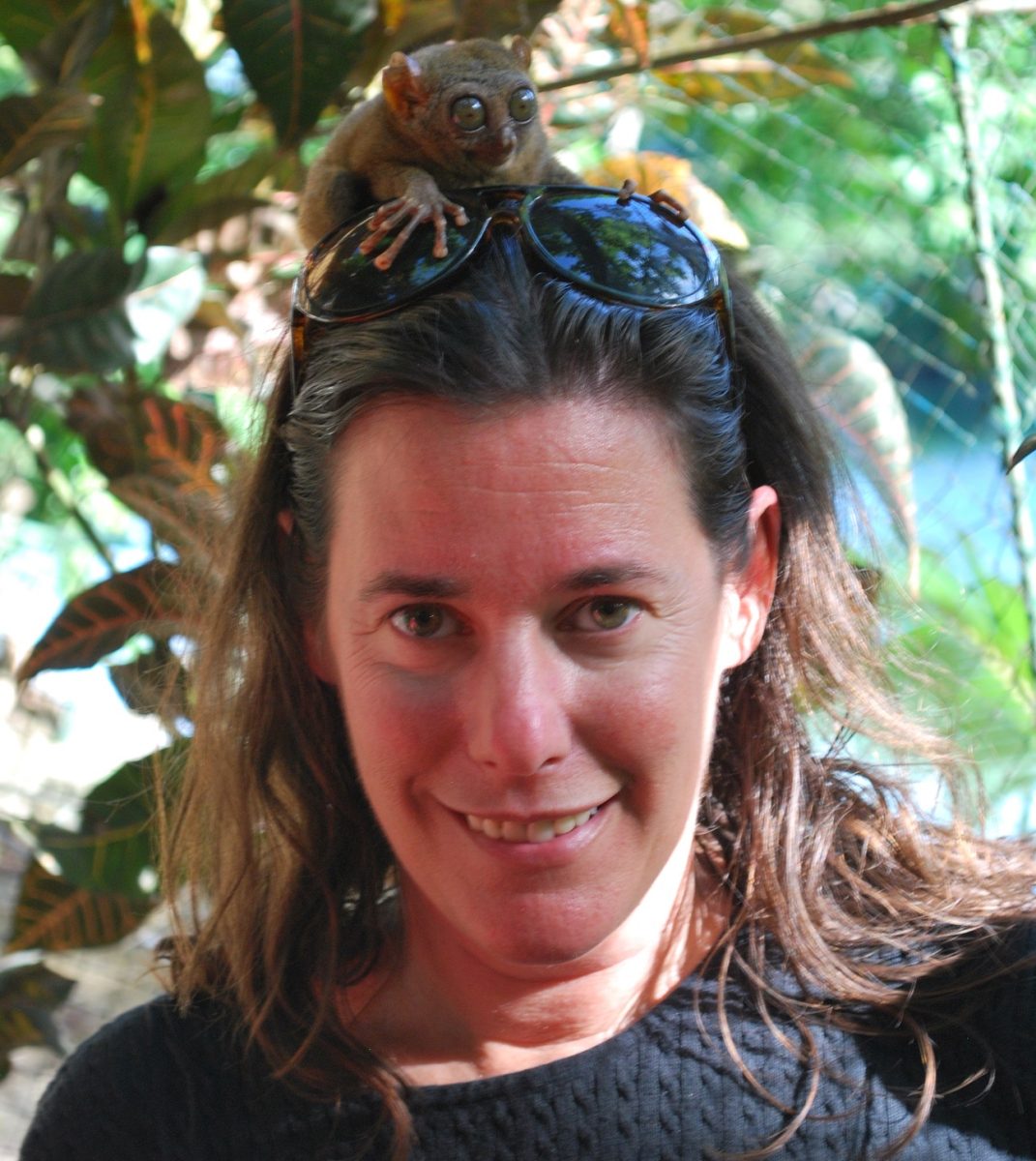
The scorchingly humid air of Uganda, Indonesia and the Philippines are a world away from the third floor of Texas A&M’s Anthropology Building, where the office of anthropology professor Sharon Gursky, Ph.D., resides — yet Gursky has built a career exploring those rainforests every year. Her field sites — rugged and chock full of nocturnal primates — are where Gursky said she feels most at home.
Gursky wasn’t born with love for her craft. Her journey began with an internship assignment that slipped into a career-defining discovery.
“When I was in college, I had to do an internship,” Gursky said. “They found an internship for me at the primate center, and while I was there, I was working with animals, and I realized how much I loved it. And that’s how it started.”
She has spent decades working with tarsiers, tiny primates known for their enormous eyes and ancient evolutionary lineage. Tarsiers belong to a group of primates that have existed for roughly 50 million years, according to University of Chicago scientists. Their peculiar traits — including eyes whose volume exceeds that of their brain, as Gursky shared — are tailored to their nocturnal behavior.
Gursky’s contributions to the research of tarsiers over the years have proven so influential that the species was renamed in her honor. The scientific name was changed from Tarsius spectrum to Tarsius spectrumgurskyae, or Gursky’s spectral tarsier.
Gursky said that while primatology may not be a high-paying profession, her passion has been the driving force of her work.
“I love what I do,” Gursky said. “I get to travel around the world and hike in rainforests — I go hiking in Madagascar, Indonesia, Uganda, chasing monkeys, and this is my job.”
Gursky’s work sends her into some of the most vulnerable ecosystems on the planet. Rainforest habitats in Southeast Asia face rapid deforestation due to modern pressures such as logging and agricultural expansions, meaning the progression of human infrastructure and land-use expansion directly renders native species under threat of resource and habitat scarcity. For Gursky, each fieldwork season is a chance to collect data that may contribute to the preservation of species fighting for survival.
“When I’m in that four-wheel-drive vehicle going on a bumpy road to my field site, and I see it in the distance, I can just all of a sudden feel like I can start to breathe,” Gursky said.
However, not every moment in the field is peaceful. On an island in Indonesia, Gursky was conducting a population survey of slow lorises when her guide suddenly froze.
“All of a sudden [the guide] stopped, and I’m like, ‘Keep going,’” Gursky said. “Then he grabs my head, turns it and I look up and go, ‘Oh my God.’”
Just 10 feet above them sat a clouded leopard, a notoriously powerful predator native to rainforests in Southeast Asia. Gursky said that memory was one that’s only fun to tell after the fact.
“It was doing that growl,” Gursky said. “We slowly started backing up … nobody would ever go into the forest with me again after that.”
Gursky’s adventures in primatology extend beyond fateful encounters with apex predators — it stretches as far as rediscovering a species thought to be extinct. The pygmy tarsier, a two-ounce nocturnal primate, had not been seen in over 70 years and was believed to be extinct by conservation groups. Gursky said The International Union for the Conservation of Nature had reached out for her opinion on the species’ status, to which she replied that she didn’t know.
Then, they asked her to take a look.
“National Geographic gave me money,” Gursky said. “On the second night there, my graduate student and I found a live population.”
Their find went on to rewrite the understanding of the species, which Gursky said reignited scientific attention toward tarsiers.
“These guys are incredibly tiny — about two ounces,” Gursky said. “You’re going and looking in the forest for something that tiny and nocturnal.”
Gursky said every species plays a role in its ecosystem, and that they’re all interconnected. Whether she’s trekking through Madagascar at dusk, redirecting from a clouded leopard’s gaze or mentoring the next generation of primatologists, the mission remains the same: preserving what can be saved.
“I know I’ll never be rich,” Gursky said. “But I love what I do — and not most people who get jobs just to make money can say that.”









!["2026 [Hillje, Tilly]/The Battalion. All rights reserved.”](https://thebatt.com/wp-content/uploads/2026/04/IMG_5581-1-1200x800.jpg)





Zarik Khan • Feb 26, 2026 at 1:05 am
Incredible piece of writing, I feel like I learned so much about animals, and the hardwork that goes into research from this article. It really pushed my horizons in alot of ways and made me grateful for researchers like Gursky. Props to the author for a dynamic and engaging article.