



As winter turned to spring and the cold winds of the new year warmed — or, in the heart of Texas, as we reached 90 degrees — the latest holiday on the calendar officially passed. Situated comfortably between St. Patrick’s Day and Mother’s Day, this year’s Easter week came and went in the blink of an eye.
My memories of Easter are just as warm as the day it annually occurs on. I grew up with all the fun traditions you can imagine: hunting Easter eggs, getting a basket full of treats and taking an annual family photo right after church.
Just like Thanksgiving and Christmas, Easter has gotten the cosmetic treatment of commercialism. With the skyrocketing price of eggs and cheap bunny wreaths in H-E-B aisles dominating this time of year, it isn’t a stretch to suppose that future generations might look back on the 21st century and wonder why we worshipped a rabbit for a few weeks every spring.
Don’t mistake my words; I love all the traditions and games that come with the holiday season. But it would be remiss to forget that underneath all the pastel colors and Cadbury Creme Eggs, there is a true — and much more important — reason for the season.
If you haven’t heard it before, allow me a moment to share the Easter story with you.
About 2000 years ago, a baby was born in a stable. This baby was the Son of God, Jesus Christ. He grew up to preach a gospel of love and hope for humanity, a message received — but not by all.
The Jews arrested him and turned him over to the Romans, who beat and crucified him. He died on a Roman cross.
Death had won — or so they thought.
Three days later, Jesus rose from the dead. He conquered death, an indisputable resurrection. As Charles Spurgeon said, “There were so many witnesses to behold it, that if we do in the least degree receive the credibility of men’s testimonies, we cannot and we dare not doubt that Jesus rose from the dead.”
I once had a Sunday school teacher berate me for calling this a story, since it was something that actually happened. Storytelling, however, isn’t merely fictional. It can be imagined, of course — I love a fire-breathing dragon or laid-back hobbit as much as the next person — but that isn’t the purpose of a story. The purpose of a story is to share knowledge, to connect with people in a way that conversations often fail to.
The Bible is the greatest story — the greatest written biography — ever told.
Maybe you’re scoffing at that. I understand the thought of a man going from dead to alive is shocking and even unbelievable, and to that I simply ask you to stay for a moment longer. Christ-believer or not, I’m certain there are days during which you need hope, and it seems impossible to find. There is no lasting hope in politicians, television or food; there is no hope in human understanding.
It follows, then, to say that the only place to find hope is in something beyond human understanding. It follows that the elusive creature of peace might be found hanging on an Easter cross.
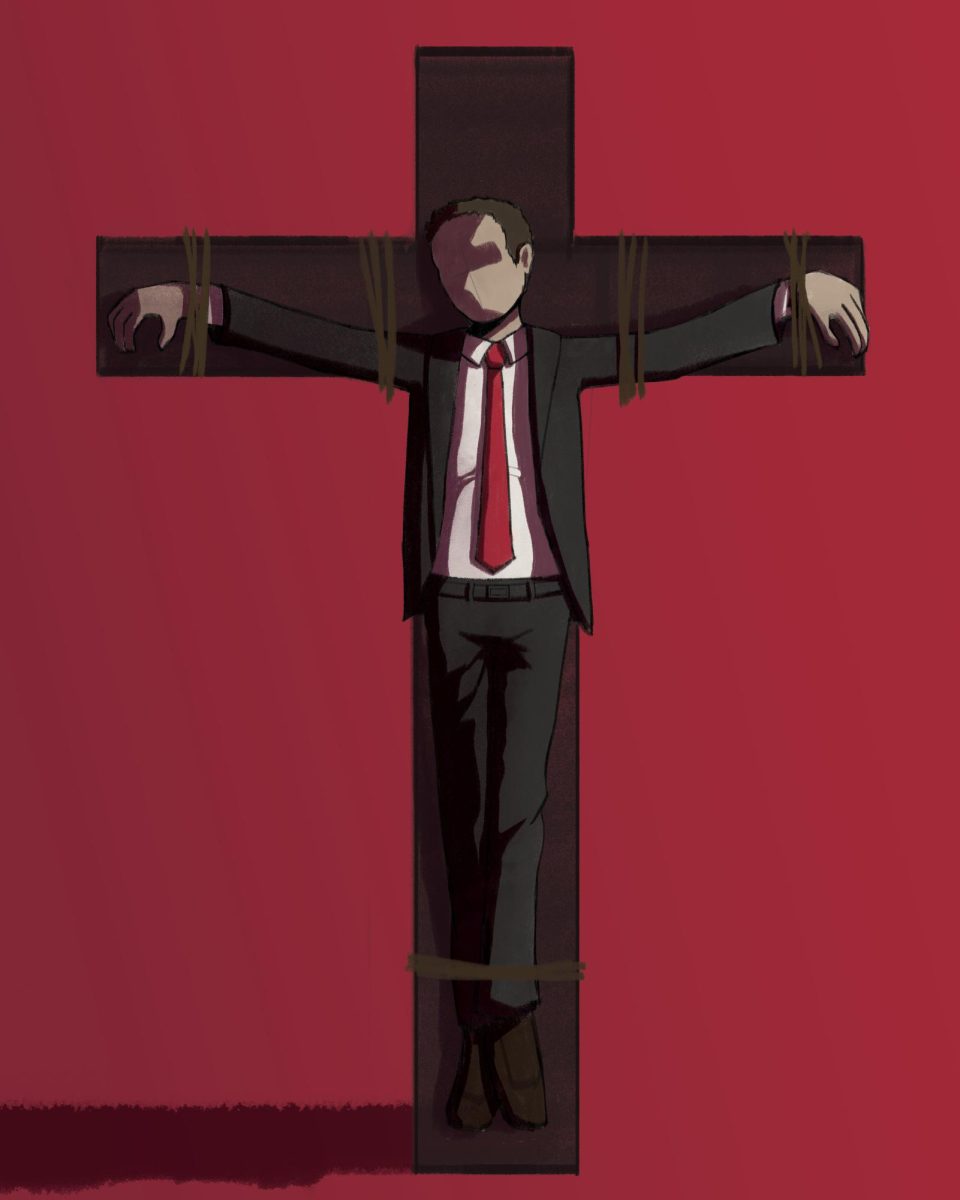
One of the most celebrated images at Easter is the cross. It’s hung on doors, painted in windows, printed on shirts — but we must never forget that the cross itself is not beautiful.
Do you call a guillotine wonderful? Do you admire a noose? Crucifixion was a brutal method of execution created by the Romans to induce death by asphyxiation and organ failure. And yet we find hope in it. Why?
Many, perhaps yourself included, can’t understand the reason for Christians rejoicing at an ugly piece of wood that was used to bring the death of our savior. But the beauty of the cross lies in the message it conveys as a symbol of Christianity.
We celebrate death because it means life. The cross represents the hope of resurrection and the reality that only through the haze of the pain the cross projects can we see and understand God’s great love for us.
That’s why it’s important we celebrate the entire Easter week, not just the day. In light of such sacrifice, such eternal love, how can we cheapen it? How can we raise an imagined rabbit over the Son of the living God?
I’ve always found holidays to be a bright spot during the year. Easter typically falls right around the end of the semester, when stress is high and students pull themselves free from studies for a few brief days to enjoy some sunshine, jelly beans and family time. Unfortunately, reducing the celebrations to solely commercial elements takes away the heart of the holiday.
Have you ever had a cinnamon roll? Everyone knows there’s only one way to eat them — from the outside in — saving the best part, the center, for last.
Taking Jesus out of Easter is like eating a cinnamon roll, reaching the middle and finding no center. Sure, you had a cinnamon roll. Does it matter, though, if the best part is missing?
Marie Kneeland is an English honors freshman and opinion writer for The Battalion.











Robert • Apr 14, 2026 at 4:25 pm
Excellent article and spot on for everyone’s need of the saving grace of Christ. He is one and true God, Amen!
Carol Kettlewell • Apr 11, 2026 at 1:52 am
You have so much talent. I know you give God the glory for that talent and I pray that you always use it just the way you have in this piece.
jayanthi abraham • Apr 10, 2026 at 4:48 pm
Great article!
Kell Brigan • Apr 9, 2026 at 11:55 pm
Then stop calling it “Easter.” Easter is the festival of the Goddess Ostara, bunnies and all. Christians are the ones who decided to (try to) steal other religion’s holidays and symbols.
Andrew • Apr 9, 2026 at 8:12 am
Powerful. Profound. Timely. Amen!